
How to Measure Replacement Door Handles
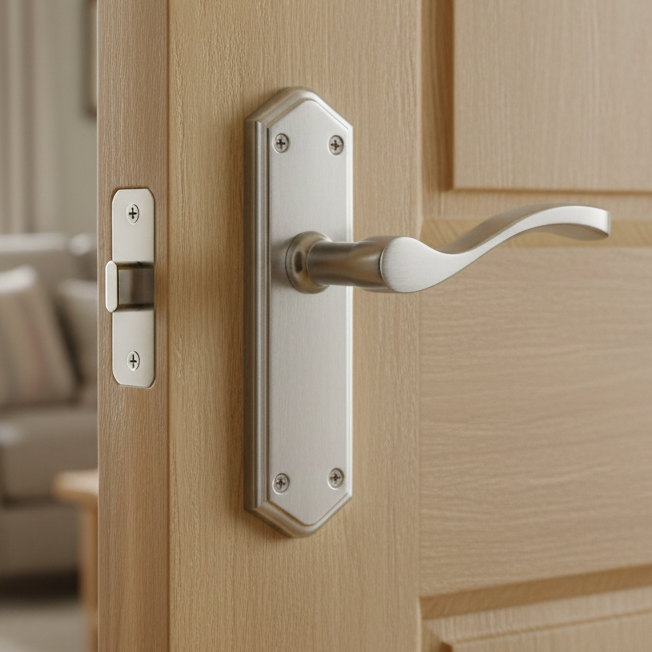
Replacing door handles is usually straightforward, but only if the new handles match the door, latch, lock and fixing points already in place. The most common problems happen when a handle looks right online but the screw holes, spindle, keyhole, backplate or lock centres do not line up once it arrives.
The good news is that you do not need to be a professional fitter to take the right measurements. You just need to know what to measure and where to measure from.
This guide walks you through the main measurements to check before buying replacement door handles, including internal lever handles, backplate handles, lever on rose handles and uPVC door handles.
Before You Start: Do Not Remove the Handle Yet
If the handle is still fitted to the door, leave it in place while you take your first measurements. It is often easier to measure the backplate, screw centres and keyhole position while everything is still lined up.
You may need to remove the handle later to check the spindle or lock, but start with the visible measurements first. This helps you avoid losing the position of the existing fittings.
You will need:
-
A tape measure or ruler marked in millimetres
-
A pencil and paper
-
A screwdriver, if you need to remove the handle
-
Your current handle still fitted, if possible
-
Good lighting so you can see the fixing points clearly
Always record measurements in millimetres. Door furniture is usually listed in metric sizes, and small differences can matter.
The Measurements That Matter Most
The measurements you need depend on the type of handle you are replacing. However, most replacement jobs involve some or all of the following:
-
Backplate length
-
Backplate width
-
Screw-hole centres
-
Spindle size
-
Door thickness
-
Keyhole or turn position
-
Latch or lock backset
-
PZ measurement for uPVC handles
-
Overall handle projection
-
Whether the handle needs to cover old marks
You do not always need every measurement, but taking more information now makes it much easier to choose confidently.
Measurement 1: Backplate Length and Width
If your existing handle has a long plate behind the lever, measure the full height and width of that plate.
Measure from the very top of the backplate to the very bottom. Then measure across the widest part of the plate.
This matters because the new handle needs to look neat on the door. If the new backplate is much smaller than the old one, it may leave old screw holes, paint marks or faded outlines visible.
A replacement backplate does not always need to be exactly the same size, but it should be large enough to cover any marks you do not want to see.
This is especially important if:
-
The door has been painted around the old handle
-
The old handle has been fitted for many years
-
There are visible screw holes
-
You do not want to repaint or repair the door
-
You are replacing handles throughout a property and want a clean finish
If your current handles are on a backplate, replacement door handles on backplate are often the easiest route.
Measurement 2: Screw-Hole Centres
Screw-hole centres are the distance between the fixing screws on the handle plate or rose.
Measure from the centre of one screw hole to the centre of the other. Do not measure from the edge of the screw head. Centre-to-centre is the important measurement.
If the new handle uses the same screw positions, replacement is usually simpler. If the screw holes are different, you may need to drill new fixing holes or repair the old ones.
This is not always a problem, but it is worth knowing in advance.
For backplate handles, there may be two, three or four visible screws depending on the style. For lever on rose handles, the fixing screws may be hidden beneath the rose cover, so you may need to remove the cover carefully to inspect them.
Measurement 3: Spindle Size
The spindle is the square bar that passes through the door and connects the two handles. When you press the handle down, the spindle turns and operates the latch or lock.
Most internal lever handles use a square spindle, but you still need to check that the spindle fits correctly and is long enough for the door thickness.
If you are reusing the existing spindle, check that it is not rounded, worn or damaged. A worn spindle can make the handle feel loose even when the handle itself is fine.
If your new handles come with a spindle, compare it with the old one before fitting. It should pass through the latch or lock smoothly and allow both handles to sit properly on the door.
Measurement 4: Door Thickness
Measure the thickness of the door at the edge. This helps you check whether the spindle and fixings are suitable.
Many internal doors fall within a common thickness range, but it is still worth measuring. Older doors, fire doors, external timber doors and some specialist doors may be thicker than expected.
Door thickness can affect:
-
Spindle length
-
Fixing screw length
-
Whether bolt-through fixings will work
-
How securely the handle sits
-
Whether additional fitting parts are needed
If the door is unusually thick or thin, check the product details carefully before ordering.
Measurement 5: Keyhole Position for Lock Handles
If you are replacing a lock handle, the keyhole position is one of the most important measurements.
Measure from the centre of the handle spindle to the centre of the keyhole. This tells you whether the keyhole in the new handle will line up with the lock already inside the door.
If this measurement is wrong, the handle may fit onto the door but the keyhole will not align with the lock. That means the key will not work properly.
You should also check the shape of the keyhole. Some handles are designed for standard mortice keyholes, while others are designed for Euro profile cylinders.
If the door needs to lock with a key, browse door handles with locks and check the measurements against your existing lock.
You can also view our range of door locks if the lock itself also needs replacing.
Measurement 6: Bathroom Turn Position
Bathroom handles work differently from key-lock handles. Instead of a keyhole, they usually have a turn and release.
If you are replacing bathroom handles on a backplate, measure from the centre of the handle spindle to the centre of the bathroom turn. The new handle needs to line up with the bathroom lock inside the door.
If you are using lever on rose handles, the bathroom turn is usually a separate fitting. In that case, you need to make sure the turn and release lines up with the bathroom lock and looks balanced below the handle.
For privacy doors, you may need bathroom door handles or a separate bathroom thumb turn lock.
Measurement 7: Latch or Lock Backset
The backset is the distance from the edge of the door to the centre of the handle spindle.
This matters because it affects where the handle sits on the door. If you are keeping the existing latch or lock, the backset is already set. If you are fitting a new latch or lock, you may have more choice.
A shorter backset places the handle closer to the door edge. A longer backset places it further in from the edge.
If you are replacing like-for-like, measure the existing latch or lock and choose a compatible replacement where needed.
For standard internal doors, many handles are used with tubular latches.
For more detail on choosing the right latch, you can also read our guide to choosing latches to go with your door handles.
Measuring Lever on Rose Handles
Lever on rose handles need slightly different checks because the fixing plate is smaller.
Start by measuring the rose diameter or square rose size. This tells you how much of the door surface the new handle will cover.
This is very important when replacing older handles. If the previous handle had a large backplate, a smaller rose may not cover the old screw holes or marks. You may need to fill and repaint the door before fitting lever on rose handles.
For lever on rose handles, check:
-
Rose diameter or width
-
Spindle size
-
Existing screw-hole marks
-
Door thickness
-
Latch condition
-
Whether you need escutcheons or a bathroom turn
-
Whether the handle is sprung or unsprung
Lever on rose handles are a good choice for a clean, modern finish, but they are less forgiving if the door has visible marks from older fittings.
Shop lever on rose door handles
Measuring Backplate Handles
Backplate handles are often easier to measure because the plate gives you several visible reference points.
Measure:
-
Overall backplate length
-
Overall backplate width
-
Screw-hole centres
-
Handle spindle to keyhole distance, if it is a lock handle
-
Handle spindle to turn distance, if it is a bathroom handle
-
Door thickness
-
Existing latch or lock position
If you are replacing an old backplate handle, try to choose a new handle that covers the same area or slightly more. This helps hide old marks and gives a neater finish.
Make sure you choose the right type of backplate handle:
-
Latch backplate for normal internal doors
-
Lock backplate for key-operated doors
-
Bathroom backplate for privacy doors
Shop door handles on backplate
Measuring uPVC Door Handles
uPVC and composite door handles require more precise measurements than standard internal handles. These handles usually work with multipoint locking systems, so the handle must line up correctly with the lock.
The three most important measurements are:
PZ measurement
This is the distance from the centre of the handle spindle to the centre of the keyhole.
Screw fixing centres
This is the distance between the fixing screws.
Backplate length
This is the full length of the handle plate from top to bottom.
You should also check:
-
Backplate width
-
Spindle size
-
Whether the handle is inline or offset
-
Whether the handle is lever/lever or lever/pad
-
Whether the handle is sprung or unsprung
-
Door thickness
-
Existing lock operation
If the PZ measurement is wrong, the keyhole will not line up with the cylinder. If the screw centres are wrong, the handle will not fit the existing fixing holes.
For uPVC and composite doors, do not guess. Measure carefully before ordering.
For a more detailed uPVC-specific guide, read How to Measure uPVC Door Handles.
A Simple Measurement Checklist
Use this checklist before ordering replacement handles.
For standard internal latch handles:
-
Door thickness
-
Spindle size
-
Latch condition
-
Backplate or rose size
-
Screw-hole positions
-
Whether old marks need covering
For lock handles:
-
Backplate size
-
Screw-hole centres
-
Spindle to keyhole measurement
-
Lock type
-
Door thickness
-
Existing lock condition
For bathroom handles:
-
Backplate size or rose size
-
Spindle to bathroom turn measurement
-
Bathroom lock position
-
Door thickness
-
Whether a separate turn and release is needed
For uPVC handles:
-
PZ measurement
-
Screw fixing centres
-
Backplate length
-
Backplate width
-
Spindle size
-
Lever/lever or lever/pad style
-
Inline or offset handle position
Taking a few extra measurements now can help you avoid ordering the wrong handle.
Should You Replace the Latch or Lock at the Same Time?
If your existing latch or lock works smoothly, you may be able to keep it. However, if it feels stiff, loose, noisy or unreliable, it is often sensible to replace it while changing the handles.
A new handle fitted to an old sticking latch may still feel poor. Sometimes the handle is blamed when the real issue is the latch or lock inside the door.
Signs the latch or lock may need replacing include:
-
The handle does not return properly
-
The latch sticks
-
The door only closes if pushed hard
-
The key is stiff
-
The lock feels loose
-
The latch bolt does not retract smoothly
-
The handle droops even after tightening
If you are unsure, remove the handles and test the latch or lock separately with the spindle. If it still feels stiff without the handles attached, the latch or lock may be the problem.
You may find our guide on drooping door handles that do not spring back useful if the handle is not returning correctly.
What If the New Handles Do Not Use the Same Holes?
This can happen, especially when changing style.
If the new handle uses different fixing holes, you may need to drill new ones. The old holes may need filling if they are visible or too close to the new fixings.
If you are switching from backplate handles to lever on rose handles, old marks are more likely to show because the rose is much smaller than the original plate.
If you want to avoid repainting or repair work, choose a replacement handle with a backplate large enough to cover the old marks.
If the door is hollow or the screw fixings are weak, you may need a more secure fixing method. Our guide to repairing loose door handles on hollow doors explains this in more detail.
Common Measuring Mistakes
One common mistake is measuring from the edge of a screw instead of the centre. Always measure centre to centre.
Another mistake is only measuring the overall handle size and forgetting the keyhole or turn position. This can cause lock and bathroom handles to misalign.
A third mistake is assuming uPVC handles are universal. They are not. PZ measurement and screw centres must match.
People also often forget about old marks on the door. A new handle may technically fit, but if it does not cover the previous plate outline, the finished result may not look right.
Finally, do not assume that all doors in the same property are identical. If you are replacing several handles, check a few doors before ordering. Older properties often have slight differences from room to room.
Can You Replace Door Handles Without Measuring?
Sometimes, if you are buying an exact like-for-like replacement. But in most cases, measuring is safer.
Even small differences can cause issues. The handle may not cover the old marks. The keyhole may not line up. The screws may not fit the same holes. The spindle may be too short. The bathroom turn may sit in the wrong place.
If you are replacing one handle and can compare it directly with the new one, the process may be simple. If you are ordering online, measurements are your best way to check compatibility before buying.
You can also read our guide: Can You Just Replace Door Handles?
Final Advice Before Ordering
Measure carefully, write everything down, and compare your measurements with the product details before ordering.
For standard internal doors, the key things to check are the handle style, latch condition, spindle size, screw positions and whether old marks need covering.
For lock and bathroom handles, pay close attention to the position of the keyhole or turn.
For uPVC and composite doors, check the PZ measurement, screw centres and backplate size before anything else.
If you are fitting new handles throughout a property, consider whether door handle packs may be easier than buying each part separately.
Replacing door handles is usually simple when the measurements are right. A few minutes with a tape measure can save time, avoid returns and help you get a cleaner, better-fitting result.
Shop door handles on backplate
