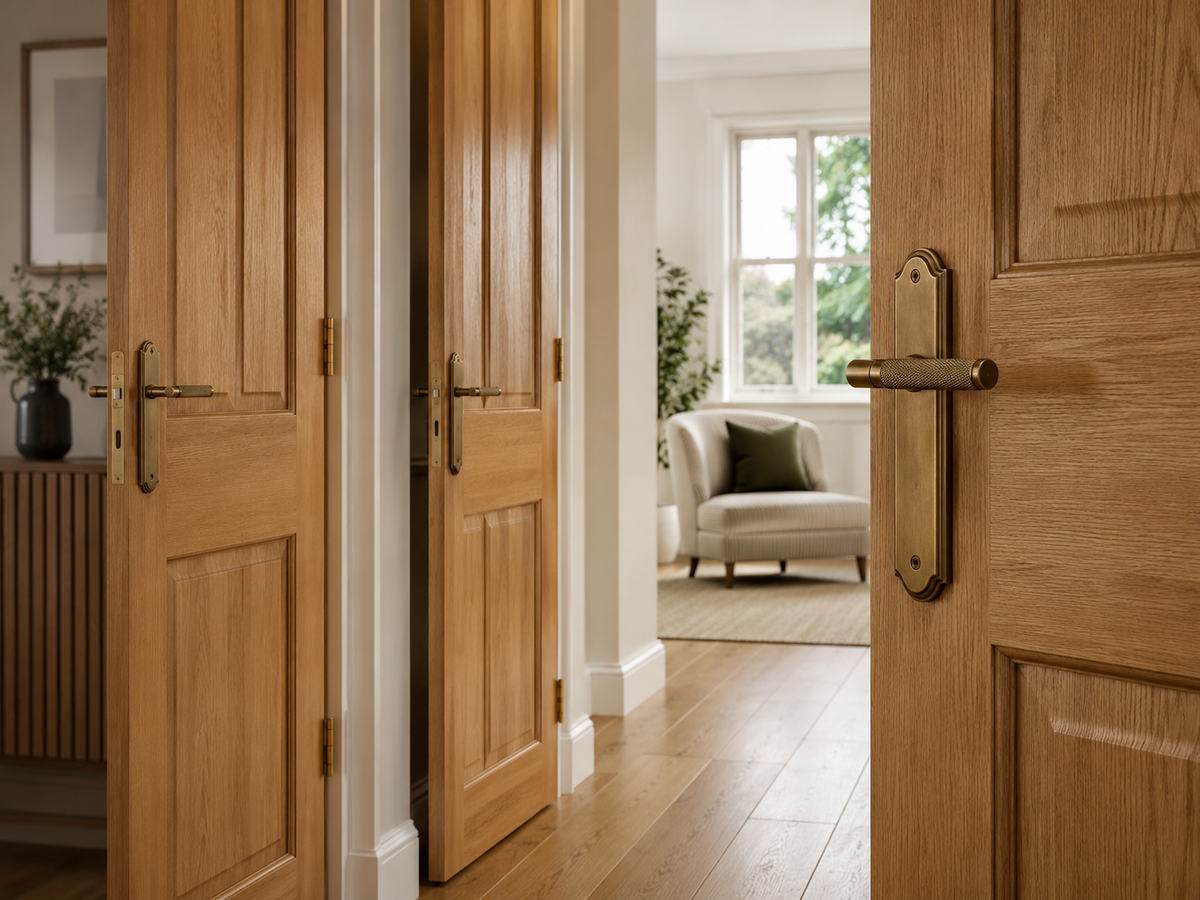
Antique Brass Knurled Door Handle Ideas & Inspiration

Some door handles are chosen mainly for their shape or finish. A knurled handle adds another consideration altogether: how it feels. The fine, cross-hatched texture gives your fingers something to engage with each time you open the door, turning an everyday fitting into a much more tactile part of the room.

In antique brass, that texture becomes especially interesting. The tiny raised pattern catches light differently across the lever, revealing warmer brass highlights alongside darker aged tones. From a distance the handle can look restrained; up close, there is considerably more detail. That balance makes antique brass knurled door handles a strong choice when you want something distinctive without choosing an ornate or heavily decorative design.

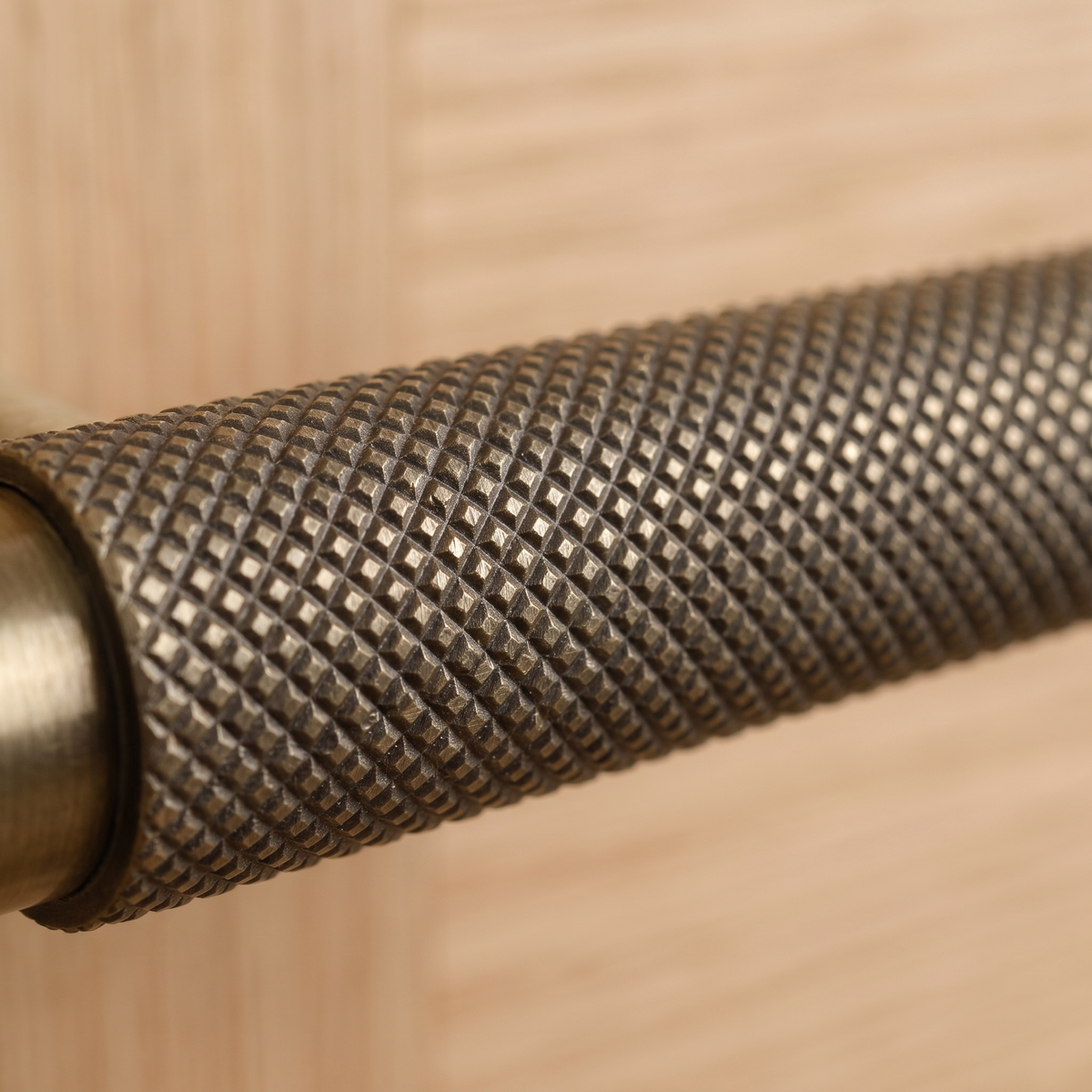
The Heritage Signac Antique Brass Door Handle shows why knurling rewards a closer look: the lever appears simple in silhouette, but its surface is covered in fine diamond detail.

The detail is the design

Why choose a knurled door handle?

Knurling creates a repeating pattern of small grooves across the surface of the lever. It began as a practical way of adding grip to metal components, but on architectural hardware it has become a decorative feature in its own right. The pattern introduces shadow, texture and a slightly engineered character without requiring an elaborate handle shape.

01

More to feel

Unlike a completely smooth lever, the patterned surface can give the fingers more purchase. It is a small difference, but one you notice every time the handle is used.

02

More to see

Hundreds of tiny facets catch and lose the light as you move around the door, so antique brass appears deeper and more varied than it does on a completely flat surface.

03

Less need for ornament

Because the texture provides the interest, the rest of the handle can remain relatively simple. That is why knurled designs suit contemporary interiors particularly well.

Look closely

A pattern made for side light

Knurled hardware looks particularly good where natural or artificial light travels across the door rather than hitting it completely straight on. Light catches the tops of the pattern while the grooves remain darker, making the texture much easier to see.

This is worth considering in hallways with wall lights, bedrooms with bedside lighting, or rooms where daylight enters from a window positioned beside the door. You do not need to spotlight the handle; even gentle side light can make the surface considerably more noticeable.

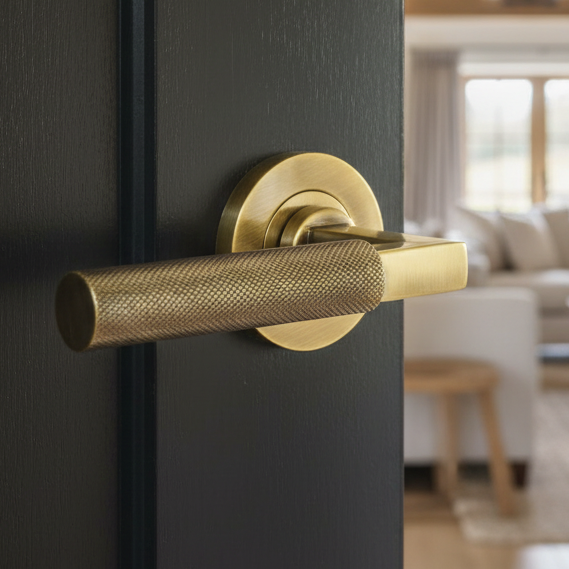
The Signac lever on rose uses diamond knurling across most of the hand-grip area, so the texture becomes the main decorative feature rather than an accent.

Interior direction

Think tailored, not industrial

Knurling is sometimes associated with industrial interiors because of its engineered appearance. Antique brass changes that character. The warmer finish softens the precision of the pattern, so the same handle can sit just as comfortably with upholstered furniture, panelled joinery, natural stone and calm neutral paint colours.

For a more refined scheme, avoid surrounding the handle with too many obviously industrial materials. Pair it with chalky off-whites, taupe, dark painted joinery, oak, walnut, marble-effect surfaces or textured fabrics. The handle then provides the harder, more precise detail within an otherwise softer room.

Where knurled antique brass works particularly well

The appeal of a textured handle is strongest in rooms where you interact with the door frequently or where the hardware can be appreciated at close range. Rather than treating every door identically, you can use knurling strategically.

→

Hallways and landing doors

These handles are used constantly and often viewed from several angles. A knurled lever gives an otherwise simple run of doors a repeated architectural detail without needing bold door colours.

→

Home offices and studies

The precision of the pattern sits naturally alongside desks, fitted shelving and task lighting. Antique brass stops the room becoming too hard-edged and works especially well with darker painted cabinetry.

→

Bedrooms

Knurled antique brass can provide a small amount of sharper detail amongst linen, upholstery, carpet and other soft materials. It is an effective way of making a neutral bedroom feel more considered without adding another colour.

→

Bathrooms and ensuites

Stone, tile and smooth sanitaryware provide a useful contrast to tactile metalwork. Here you can also repeat the texture in the privacy turn, creating detail at more than one touch point.

Backplate or lever on rose?

With a knurled handle, this decision has a bigger visual impact than you might expect. The texture can be identical, but changing what sits behind the lever alters the balance of the entire fitting.


Lever on rose: let the texture lead

A small circular rose leaves much more of the door visible. Visually, your attention goes straight to the lever and its knurled surface.

This arrangement suits clean internal doors, modern moulded doors and schemes where you want the fitting to look compact. The Signac antique brass handle uses a 53mm diameter rose with a 125mm lever.

Best for: minimalist detailing, contemporary rooms and situations where the door itself deserves plenty of visible space.


Backplate: give the handle more presence

A long plate creates a stronger vertical element on the door and can incorporate a keyhole or bathroom turn within the same design.

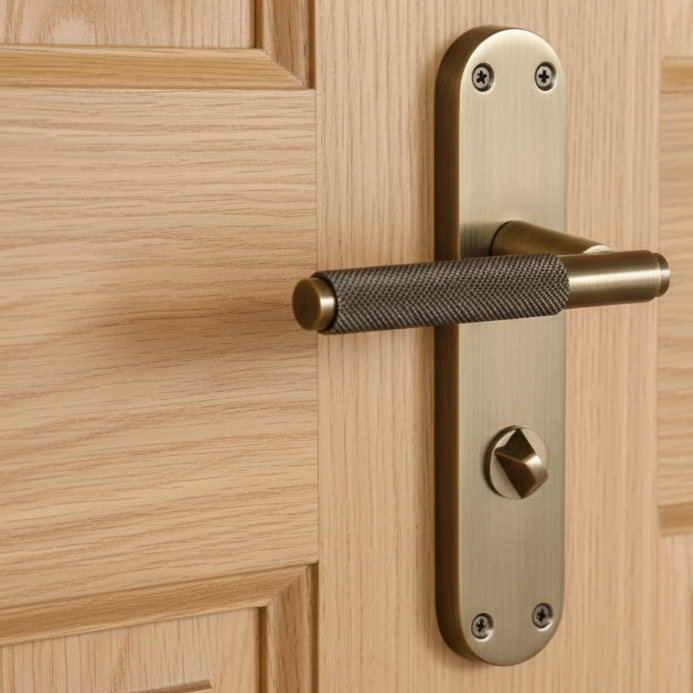
The Connaught Antique Brass Knurled Bathroom Handle, for example, uses a 185 x 40mm backplate with the textured lever and privacy turn brought together in one fitting.

Best for: panelled doors, stronger hardware detail and rooms where you want an integrated lock or privacy function.

A bathroom is a good place to make texture practical

Bathrooms are full of smooth surfaces: glazed tiles, mirrors, basins, glass screens and painted cabinetry. Against those finishes, a textured handle provides a useful point of contrast. You experience that difference through touch as well as sight.

The Connaught Antique Brass Knurled Bathroom Door Handles place the diamond-patterned grip above an integrated privacy turn. This makes them particularly straightforward if you want the handle, backplate and bathroom control to read as one piece rather than using separate fittings.

They are designed to work with a bathroom mortice lock, so remember that the visible handle is only part of the door set. The correct lock needs to be allowed for when the door is prepared.

Another way to specify a bathroom

Separate the lever from the privacy control

If you prefer the cleaner look of a lever on rose, the bathroom locking function can sit below it as a separate turn and release.

The Heritage RS2030K Antique Brass Turn & Release was designed to coordinate with the Signac lever and carries the diamond-knurled treatment onto the thumbturn itself.

This creates a satisfying visual hierarchy: a large tactile lever where the hand opens the door, then a much smaller textured control underneath for privacy.

Do not put texture everywhere

A knurled handle is effective precisely because it interrupts smoother surfaces. If every metal fitting in a room is heavily patterned, the detail can lose its impact.

A more considered approach is to decide which items are genuine touch points. Door handles, bathroom turns and frequently used cabinet handles are natural places for texture. Hinges, latch faceplates and other secondary components can remain smooth antique brass, allowing them to support the scheme rather than compete with it.

Worth emphasising
Better kept quieter
Lever grips
Door hinges
Bathroom thumbturns
Latch faceplates
Selected cabinet pulls
Strike plates
Wardrobe knobs
Every decorative accessory

Carry the idea from the door onto fitted furniture

One of the easiest ways to make knurled hardware feel deliberate is to repeat the idea somewhere else in the same room. It does not have to be the identical product. Repeating the texture is often more successful than trying to make every fitting exactly match.

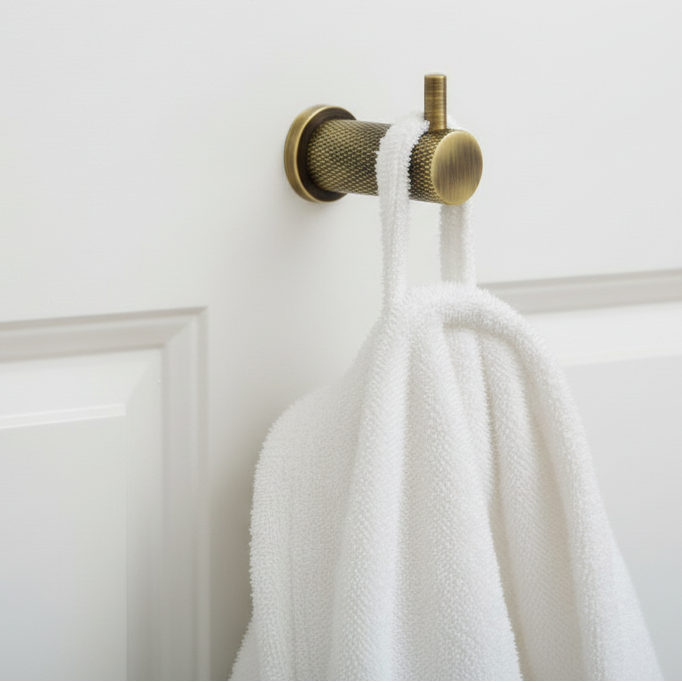
For a kitchen, dressing room, bedroom or home office, consider antique brass knurled cabinet knobs or pulls on selected cupboards and drawers. The Hoxton Wenlock Diamond Knurled Cabinet Knob is available in an antique brass option and uses knurling around its outer edge, while longer knurled cabinet handles can introduce the same idea to larger drawers and wardrobe doors.

You can also browse the wider antique brass cabinet handle collection if you would rather coordinate by finish while allowing the door handle to remain the only strongly textured element.

A useful rule: repeat, do not duplicate

If your door handle is heavily diamond knurled, your cabinet hardware does not need exactly the same proportions and pattern. One or two references to texture elsewhere in the room are enough for the eye to make the connection. That generally feels more collected and less like a matching hardware set.

Which door colours show knurling best?

Because antique brass sits in the middle of the tonal range, it can work against both pale and dark doors, but the effect changes considerably.

Very dark doors — charcoal, deep brown, black and dark blue — emphasise the warmer brass areas and give the hardware a stronger outline. This is a good choice if you want the knurled lever to become one of the first details you notice.

Warm white and neutral doors produce a softer, calmer look. Here the darker sections within the antique finish and the shadows created by the knurling provide definition without a dramatic colour contrast.

Natural timber adds another layer of texture altogether. Knurling works well against oak and other visible grains because the patterns are different enough not to imitate one another. The result can feel particularly tactile.

There is no need to restrict knurled antique brass to one particular palette. In this case, the strongest design decision is often the relationship between smooth and textured surfaces, rather than simply choosing colours that match.

How does diamond knurling feel in everyday use?

The pattern creates many small contact points between the lever and your hand, so the grip feels more textured and defined than a smooth cylindrical handle. Both the Connaught and Signac ranges use their knurling not only as decoration but to add grip to the lever.

That said, knurling should not be treated as a substitute for choosing an appropriate handle shape. If ease of operation is particularly important in your home, also consider the length of the lever, how far it projects from the door, the resistance of the latch and any door closer fitted. Surface texture is only one part of how a handle feels to use.

Check the scale before deciding

Close-up photography can make every handle appear substantial, so it is worth checking the actual dimensions against your door before ordering. The proportions are particularly important on narrow stiles, glazed doors or doors with strongly defined panels.

Design Fitting style Lever length Rose / backplate Overall projection
Signac Lever on rose 125mm 53mm diameter rose 67mm
Connaught Long backplate 115mm 185 x 40mm backplate 52mm

Choosing between a subtle and a statement knurled handle

If texture is new to your interior, start by deciding how visible you want the hardware to be from across the room. A lever on a compact rose has relatively little smooth metal surrounding it, so the texture feels concentrated and precise. A long antique brass backplate occupies more of the door and makes the whole fitting more prominent.

Neither approach is inherently more modern. A lever on rose can look crisp on a contemporary flush door but equally effective on a traditional panelled door. Likewise, a long rounded backplate can feel familiar and architectural while the knurled lever brings in the unexpected detail.

This is one reason it is useful to browse the whole antique brass knurled handle collection rather than choosing by finish alone.

Before ordering several sets

Choose one representative door and look at the whole area around it. Is the door narrow or wide? Does it have moulded panels? Will the handle sit close to a glazed section? Is the surrounding room already full of patterned surfaces?

If possible, use the published measurements to mark the approximate backplate or rose size on the door with low-tack tape. A 53mm circular rose and a 185mm long backplate create very different impressions even when viewed from several metres away.

It is also worth deciding at this stage which doors need a simple latch, which require a key-operated lock and which require bathroom privacy. Planning those functions together makes it much easier to keep a consistent knurled design language throughout the house.

Finish the installation quietly

Once the knurled handle has been chosen, the remaining ironmongery should help it rather than distract from it. Use appropriately sized antique brass locks and latches where the faceplate will be visible, and consider antique brass hinges where the hinges form part of the finished view.

The antique finish itself can vary slightly between manufacturers and production methods, so fittings from different ranges will not always be an exact colour match. If components sit immediately beside one another, coordinating products from the same range is the simplest option. Where fittings are separated — for example a door handle and cabinet knob on opposite sides of a room — a small variation can look completely natural.

Designed to be touched

Explore antique brass knurled hardware

If you like hardware that reveals more detail the closer you get to it, knurling is worth considering. Use it as a deliberate touch point, give the pattern space around it, and allow the aged brass finish to provide the warmth.

Shop Antique Brass Knurled Handles Explore All Knurled Finishes

Browse our antique brass knurled door handles for tactile lever designs, explore the wider antique brass door handle collection if you would like to compare textured and smooth alternatives, or return to our door handle inspiration pages for more ideas on choosing hardware as part of the wider interior.