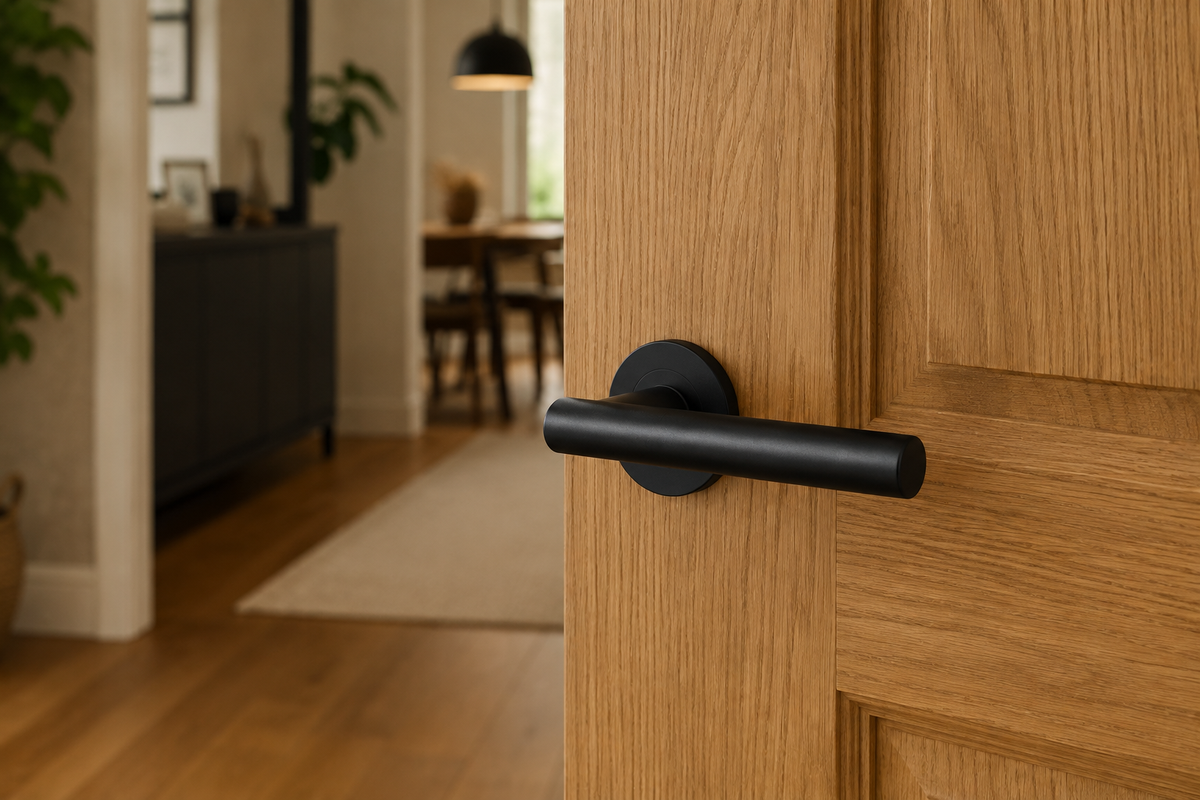
Black Door Handles on Oak Doors

Oak doors and black handles create contrast in a very different way from black hardware on a painted door. The handle still gives you a strong dark outline, but the background is not flat or uniform. Every oak door has grain, tonal variation and natural warmth, so the black fitting becomes the precise element sitting against a much more organic surface.

That tension between natural timber and dark metal is what makes the combination so versatile. It can look crisp and contemporary on a pale oak flush door, more architectural on a substantial veneered door, or distinctly rustic when black iron is used on character-grade timber. If you are choosing hardware for new oak doors — or refreshing existing timber doors — the most useful question is not simply “does black work with oak?” It is what sort of oak interior are you trying to create?

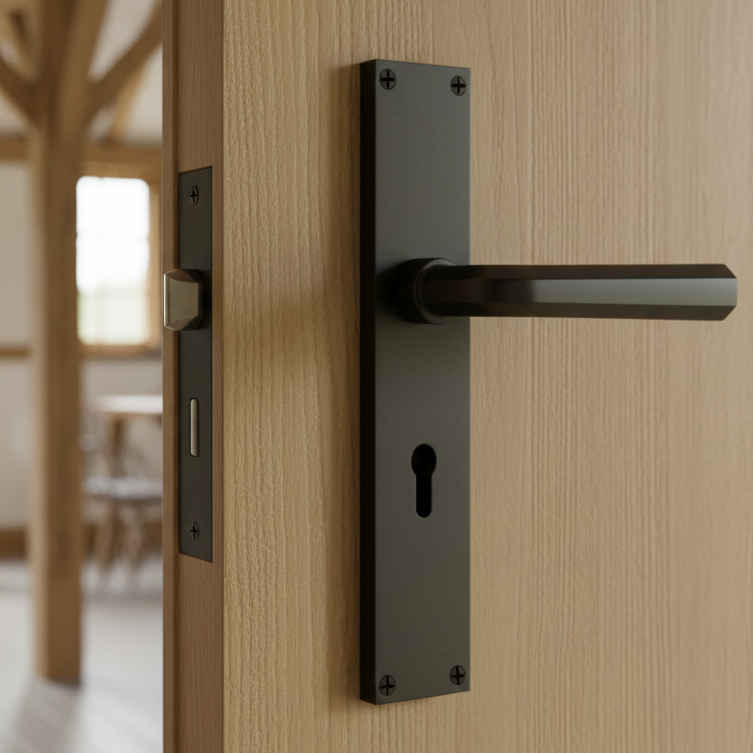
Octave matt black door handle fitted to a pale oak internal door showing the contrast between black hardware and natural wood grain
Pale oak gives matt black hardware clear definition while keeping the overall interior warm. Shown: Octave Matt Black Keyhole Door Handles.

The oak brings the warmth.

The handle brings the definition.

Start with the oak, not the handle

Oak can vary enormously. A pale, evenly grained veneered door and a knotty solid-oak cottage door may both be sold as oak, but they call for completely different hardware. Before looking at handle shapes, spend a moment identifying what gives the door its character.

Look at the depth of colour, how pronounced the grain is, whether knots are visible, whether the timber has been limed, smoked or stained, and how much detailing is built into the door itself. The busier the timber, the less work the handle usually needs to do.

Oak mood one

Pale & clean

Light natural oak, crown-cut veneer and relatively even grain create the cleanest background. Black hardware appears very clearly, so slender levers and compact roses can be enough.

Interior direction: warm white walls, limestone or pale timber flooring, simple upholstery and restrained black accents.

Oak mood two

Rich & architectural

Mid-oak, quarter-sawn grain or deeper finishes have enough visual weight to support more substantial hardware. A long backplate or geometrically shaped lever can feel intentional rather than oversized.

Interior direction: textured plaster, darker cabinetry, stone surfaces and more substantial furniture.

Oak mood three

Rustic & characterful

Knots, colour variation, ledges, braces and visible joinery change the conversation completely. Smooth modern matt black can work, but traditional black iron often relates more naturally to the craftsmanship of the door.

Interior direction: stone floors, limewashed walls, exposed timber, wool, linen and handmade-looking finishes.

Look 1: pale oak with a compact black lever

This is the lightest interpretation of the combination. The oak remains the dominant material and the handle acts like a fine black mark across it.

A compact lever-on-rose design leaves as much timber visible as possible. That is useful on a door where you specifically chose oak for its grain and do not want a large backplate covering it.

Keep the timber visible

The Shuttle: simple geometry without a large plate

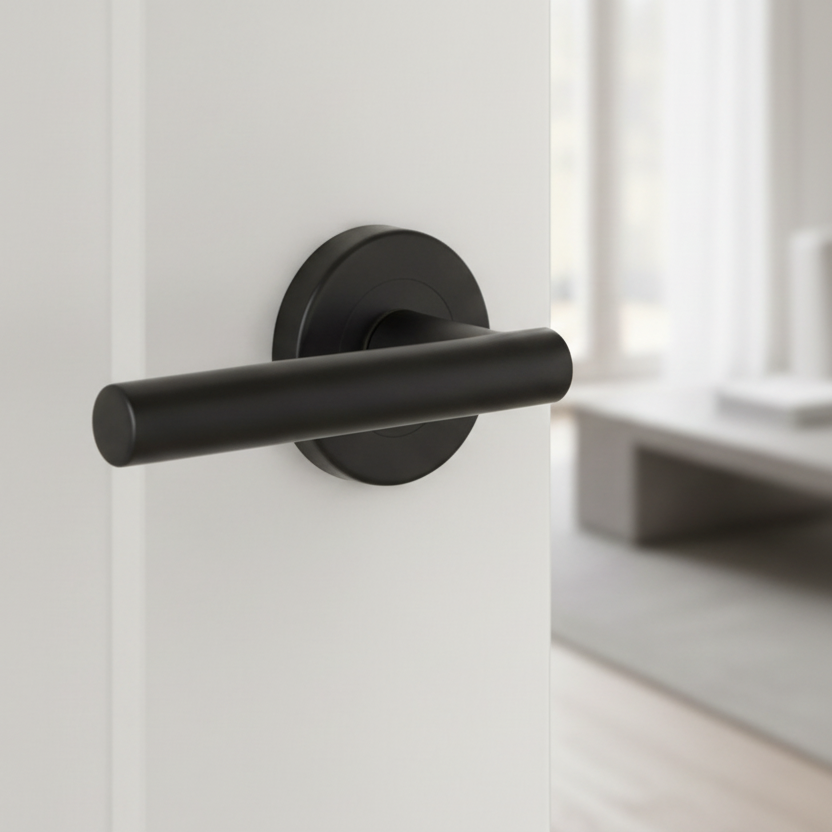
The Sorrento Shuttle Matt Black Lever on Rose uses a cylindrical T-bar lever on a 53mm circular rose. There is very little hardware behind the lever, so most of the door surface remains uninterrupted.

That makes this kind of design particularly useful on pale oak, where the grain is part of the appeal. The lever gives enough black contrast to define the opening without turning the hardware into the largest feature on the door.

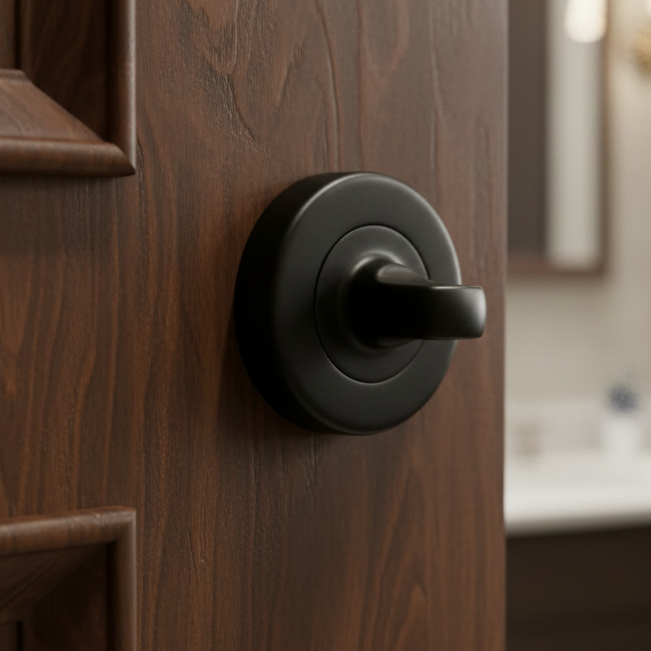
Because separate escutcheons and privacy fittings can be added where required, general latch doors can remain especially uncluttered.

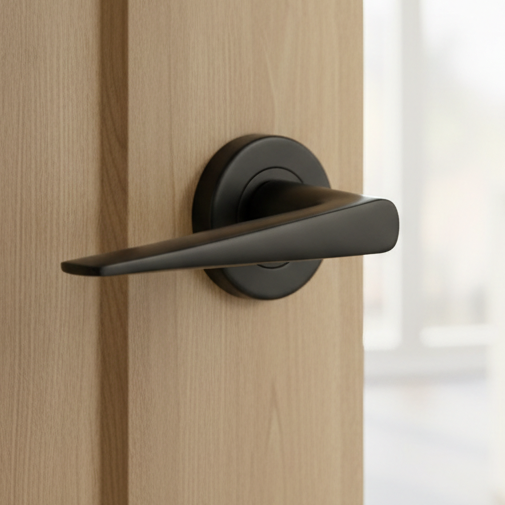
If you want an even softer silhouette, the Nero JMB700 Noir replaces the straight cylindrical form with a gently curved flat-bar lever on a 50mm concealed-fix rose. The change is small, but against oak it can make the hardware feel less technical and more furniture-like.

Look 2: make the black hardware architectural

A substantial oak door can support much more visible ironmongery. If the door is tall, wide or framed by equally substantial joinery, a tiny rose can sometimes appear under-scaled. This is where a long black backplate earns its place.

The Octave Matt Black Keyhole Handle uses a 200 × 42mm rectangular backplate and a 128mm straight octagonal lever. Instead of trying to disappear into the oak, it creates a deliberate vertical-and-horizontal composition on the door.

Why it works

The long black plate is strong enough to stand beside pronounced grain rather than becoming visually lost within it.

Where it works

Studies, dining rooms, substantial oak doors and interiors where black metal already appears in glazing, lighting or furniture.

The octagonal section is also important. Oak is full of irregular natural lines, whereas the handle is controlled and geometric. The contrast is therefore about more than colour: organic grain sits beside manufactured precision.

This can be a particularly effective route in a contemporary extension or renovation where oak has been introduced to add warmth but the architecture itself remains crisp.

Do not assume every oak door needs contemporary matt black

Oak has a long history in traditional joinery, and some doors look far more convincing with black iron than with a perfectly smooth modern lever. A ledged-and-braced oak door, for example, already has visible construction and a strong handmade character. Highly refined hardware can sometimes feel disconnected from it.

Look 3

Let rustic oak have rustic hardware

Your Black Iron Rustic collection gives a completely different interpretation of black-on-oak. The material is intentionally less visually perfect than a smooth contemporary coating, so it relates more readily to knots, irregular grain and traditional joinery.

The Claverley Black Iron Rustic Lever, for example, uses a rounded lever on a 57mm square rose. The range is produced from black malleable iron using sand-casting methods, giving the surface a rustic character while retaining a relatively simple handle shape.

This is a useful middle ground if you want oak and black iron to feel traditional without moving all the way to an elaborate scroll lever or large decorative backplate.

Explore Black Iron Rustic Door Furniture

Oak grain can tell you which handle shape to choose

Stand back from the door and look at the direction your eye naturally travels. On many oak doors the grain runs predominantly vertically. The lever then introduces a horizontal interruption across that movement.

A very straight lever makes that interruption deliberate. A curved lever softens it. A long rectangular backplate reinforces the vertical direction of the grain before the lever crosses it.

Straight, quiet grain

You have more freedom. Geometric, curved and detailed handles can all work because the door surface itself is relatively calm.

Pronounced cathedral grain

Consider simpler hardware. Strong grain already creates movement, so the handle does not need numerous decorative features as well.

Knots and rustic variation

Black iron, rounded shapes and visible fixing details can feel more at home than highly polished architectural hardware.

Smoked or darkened oak

The colour contrast decreases. Handle profile, projection and the way light catches its edges become more important than the black finish alone.

Black can make pale oak look warmer

This sounds counter-intuitive, but contrast changes how we perceive surrounding colours. Put a dark black fitting against pale oak and the honey, beige and straw tones within the timber often become easier to notice.

That is one reason black-on-oak can feel warmer than black-on-white even when the handle itself is identical. The black provides definition, but the large surrounding area is still natural timber.

You can reinforce that warmth with cream rather than brilliant-white walls, natural flooring, linen, wool and warm lighting. The room remains contemporary without relying on a cold monochrome palette.

A useful palette

Oak + black + stone + soft white

Natural oak
Matt black
Warm stone
Soft white

What if your doors are oak veneer rather than solid oak?

Visually, this need not change the design decision at all. A well-made veneered oak door can give you beautiful, consistent grain and often suits contemporary black hardware extremely well.

It does matter when the hardware is being fitted. Internal doors vary in construction, and the areas suitable for locks, latches and fixings depend on how the individual door has been manufactured. Do not assume that because the surface is oak, the entire door is solid oak beneath it.

Check the door manufacturer's instructions before preparing the door, especially with glazed, veneered, fire-rated or engineered doors. The hardware should be chosen and installed in a way that is compatible with the construction and any performance requirements of the door.

Light oak and dark oak create different amounts of contrast

High contrast

Pale natural oak

The outline of the handle is immediately visible. Compact black hardware can make a surprisingly strong impression because the background is so much lighter.

Good direction: smaller roses, simple levers, limited additional black hardware.

Medium contrast

Mid or warm oak

The hardware remains distinct but feels more embedded within the door. This tone can support both minimalist and more substantial designs.

Good direction: geometric levers, long plates or curved contemporary handles.

Low contrast

Smoked or dark-stained oak

Black becomes quieter. The handle may almost merge with the timber from across the room, creating a moodier and more understated result.

Good direction: handles with enough scale or distinctive geometry to remain legible.

Use black elsewhere — but give the oak room to breathe

Black handles are easiest to integrate when another dark element appears somewhere within the sightline. That could be a slim window frame, a pendant light, the leg of a console table or a small amount of cabinet hardware.

The danger is continuing until the natural warmth that made you choose oak in the first place becomes secondary. Black skirting, black architraves, black lighting, black furniture and black accessories around an oak door can quickly move the room away from a timber-led scheme.

Try treating black as the punctuation rather than the paragraph. The handle is one mark. A light fitting might be another. Then let oak, stone, plaster and textiles occupy most of the visual space.

The best black-and-oak interiors still look like oak interiors. The black hardware gives the timber definition; it should not compete with it for ownership of the room.

Should the hinges be black?

With an oak door, this decision is more visible than it can be on a painted door because the edge of the door is itself a feature. Black hinges create a clear dark detail against the timber every time the door is open.

If you want the hardware scheme to feel architectural, that repetition can work very well. Browse our black butt hinges to compare suitable options, but choose the hinge specification for the weight, construction and performance requirements of the door first.

If you would rather keep the face of the door focused on the handle, a less visually prominent hinge finish may be preferable. There is no requirement for every visible metal component to match exactly; the decision should support the look you are trying to achieve.

Watch what happens where oak meets black-framed glass

Oak doors are increasingly used alongside glazed screens and internal glazed doors. When those elements have black frames or glazing bars, the handle becomes a useful connector between the timber and the dark framework.

In that situation, a simple matt black lever often works better than a heavily decorative fitting because there are already several lines in the composition. A straight T-bar such as the Shuttle or a softly curved design such as the Noir can relate to the black framing without competing with it.

Always make sure the stile on a glazed door provides sufficient space and suitable construction for the proposed latch, lock and handle fixings.

One oak door can become the reference point for the rest of the house

You do not necessarily need oak doors in every room. A glazed oak kitchen door or a pair of oak doors between two principal spaces can become the natural-material feature, while painted doors elsewhere use the same black hardware finish.

This creates continuity without forcing every door to match. From the hallway, the repeated black handles link the openings together. Up close, the difference between timber and painted doors gives each part of the house its own character.

Conversely, if oak does run throughout the property, consider whether the handle needs to be identical everywhere. You may prefer a compact lever on bedroom doors, a keyhole backplate on a study and a related privacy fitting on the bathroom while retaining black as the common finish.

Before you order

Take five photographs of the door

A useful way to make the decision is to photograph the proposed door from five different positions:

1. Straight on, showing the complete door.

2. From the main hallway sightline.

3. Close enough to see the grain around the handle position.

4. With the door open, showing the edge and hinges.

5. Looking through the doorway into the room beyond.

Those views tell you far more than a close-up of the handle alone. They reveal how much hardware the door can visually carry, which other black details are visible and whether you are designing one door or an entire sightline.

Three routes through the collection

If your oak doors are pale and contemporary: start with black lever-on-rose handles. They preserve the greatest amount of visible timber and suit clean-lined doors particularly well.

If your oak doors are substantial or architectural: browse the wider matt black handle collection and compare longer backplates, geometric levers and stronger forms such as the Octave.

If your oak doors are rustic, ledged or strongly characterful: compare the Black Iron Rustic collection before choosing a smooth contemporary handle. The less uniform surface and traditional forms may relate more naturally to the door.

The final decision

Choose a handle that gives the oak contrast without hiding what makes the timber worth seeing.

For a clean contemporary result, keep the hardware compact. For a stronger architectural door, increase the scale. For rustic oak, let the finish become more characterful too.

Explore our black door handles to compare modern matt black and traditional black styles, browse black door furniture for coordinating fittings, or return to our door handle inspiration area for more ideas on matching hardware to the actual doors and interiors in your home.