Black Door Handles on White Doors

Black door handles on white doors create one of the clearest and most effective contrasts available for an interior. The white door provides an uninterrupted background, while the handle becomes a precise dark detail that can be seen from across the room. It is a simple combination, but the final result can feel minimal, architectural, graphic or softly contemporary depending on the shape of the handle and the style of the door.

The appeal is not limited to stark, ultra-modern homes. Matt black hardware can sharpen a plain flush door, define the panels of a traditional white door or bring structure to an otherwise soft neutral hallway. The key is to treat the handle as part of the door’s overall composition rather than simply choosing black because it contrasts. Explore our full range of matt black door handles while considering which type of line and level of detail will suit your doors best.

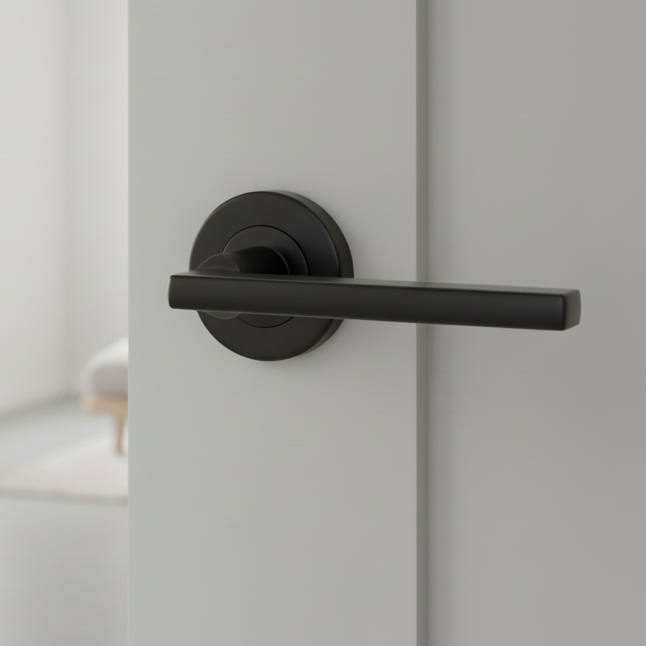
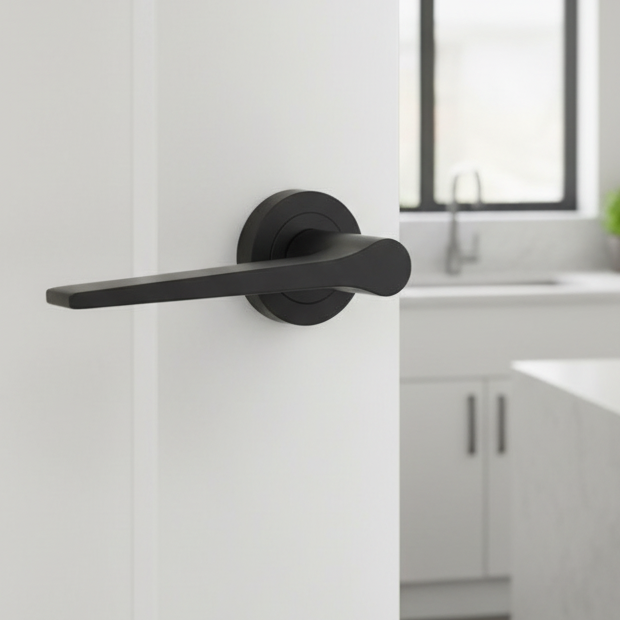
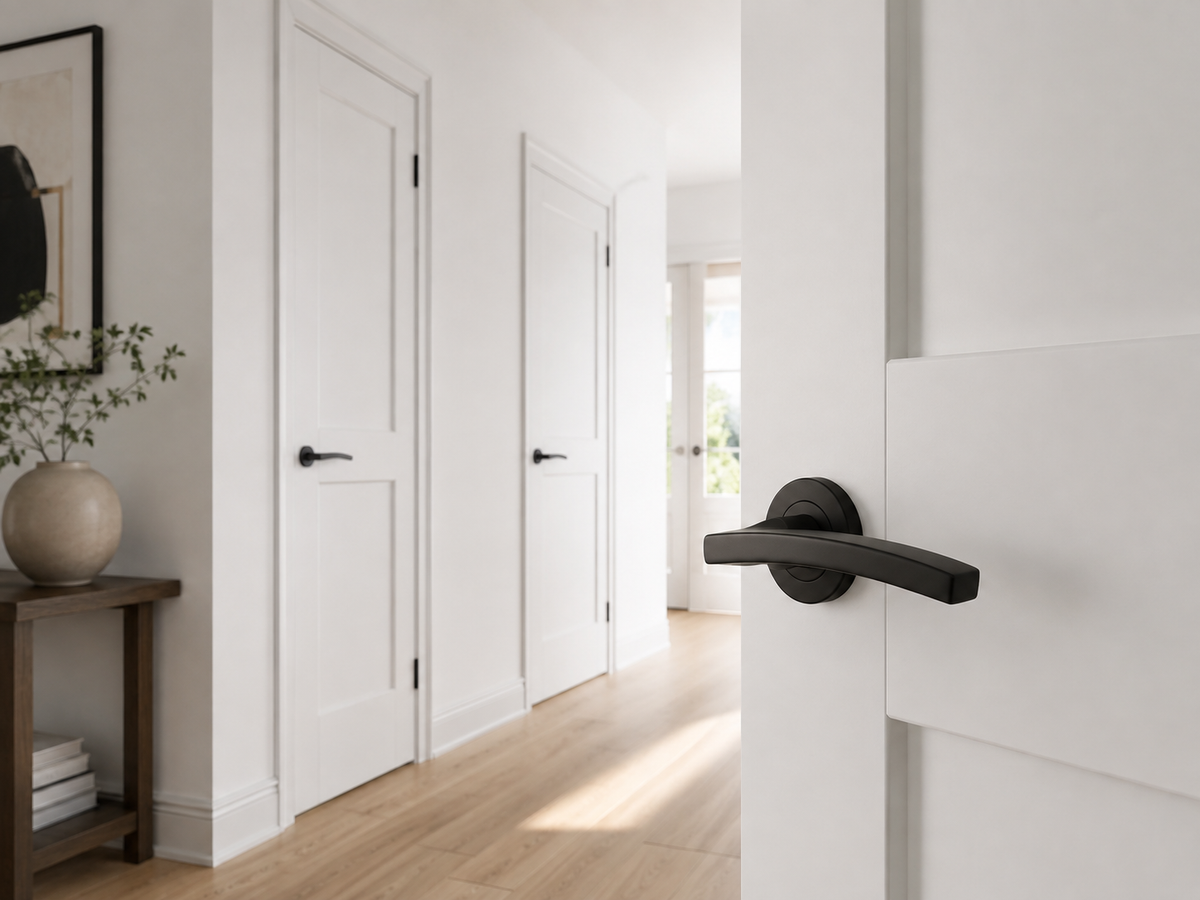
A tapered black lever creates a clear horizontal line without covering much of the white door. Shown: Geo Tapered Matt Black Lever on Rose Door Handles.

The visual idea

White creates the space.
Black draws the line.

A black handle is much easier to see against a white door than a pale or reflective metal fitting. That visibility makes every part of its shape more important: the length of the lever, the size of the rose, the curve at the end and the way the handle aligns with the panels.

This is why black-on-white schemes often feel especially designed. The hardware is not disappearing into the background. It becomes part of the drawing of the room.

Why does black hardware look so effective on a white door?

The contrast gives the eye an immediate point of reference. On a run of white doors, black handles establish a repeated height and rhythm along the hallway. On a single door, the handle can emphasise width, panel shape or the relationship between the door and nearby black features.

Matt black is particularly successful because it absorbs more light than a polished finish. It does not produce the bright reflections associated with chrome, and it does not contain the warmer colour variations found in brass or bronze. Against white, it reads as a clear shape.

That shape can be used in different ways. A long, thin lever feels linear and minimal. A curved lever softens the contrast. A long black backplate creates a much stronger vertical element. A fluted or knurled handle introduces texture while retaining the monochrome palette.

The finish creates the contrast, but the silhouette creates the style.
Choose the outline of the handle as carefully as you choose the colour.

First decide what sort of line you want the handle to draw

Because black is so clearly defined against white, two handles with the same finish can produce completely different doors. It helps to think of each lever as a drawn line rather than simply a piece of hardware.

A straight line

Crisp, calm and architectural

The Vector Matt Black Lever on Rose uses a straight square-section lever on a circular rose. The geometry is simple, so the visual effect comes from the uninterrupted horizontal line.

This type of handle suits flush doors, contemporary Shaker-style doors and interiors with black-framed glazing, slim lighting or linear cabinetry.

Choose this direction when: you want the hardware to look precise and modern without adding obvious pattern or decoration.

A sculpted line

Texture without changing the palette

The Bloom Matt Black Lever on Rose remains monochrome, but the fluted lever gives its surface more character. Light falls differently across the rounded grooves, preventing the handle from appearing like a completely flat black bar.

This is useful in rooms that feel too plain for a basic lever but where introducing a decorative metal finish would disrupt the black-and-white scheme.

Choose this direction when: you want the handle to reward a closer look while remaining clean from a distance.

A softer line

Strong contrast with gentler curves

The Diplomat Matt Black Latch Handle uses a curved lever and a backplate with subtly shaped ends. It creates more visual presence on the door, but the curves stop the black hardware feeling severe.

This design can work on both newer and more traditional white panelled doors, particularly where the rest of the room combines modern finishes with softer furniture and classic details.

Choose this direction when: you like black hardware but do not want the finished door to feel aggressively minimal.

Browse Matt Black Lever on Rose Handles

White is not a single colour

The phrase “white door” covers everything from a bright cool white to ivory, chalk, cream and pale grey. Black hardware will contrast with all of them, but the atmosphere changes according to the undertone of the paint.


Bright or cool white

This creates the sharpest result. The black appears very defined, making it a good option for modern kitchens, utility rooms, crisp hallways and homes with black-framed windows.


Warm white or ivory

The contrast remains clear, but the warmer background softens the monochrome effect. Natural timber, linen, woven rugs and warmer lighting sit particularly comfortably alongside this version.


Soft grey-white

A pale grey reduces the starkness while retaining a distinctly modern appearance. It is a useful choice when pure white feels too clinical but you still want the black hardware to remain prominent.


Putty, chalk and very pale beige

These shades still read as light neutral doors, but the black handle becomes part of a warmer, more relaxed palette rather than a strict black-and-white scheme.

Use the door panels as a guide

On a panelled white door, the handle sits within an existing arrangement of horizontal and vertical lines. The most successful choice often reinforces that geometry rather than cutting across it awkwardly.

Flush door

With no mouldings to distract the eye, the shape of the lever becomes especially important. Straight, tapered and compact lever-on-rose designs generally feel most natural.

Shaker-style door

The simple rectangular panels can support either a circular rose for contrast or a straight rectangular backplate that echoes the door’s geometry.

Traditional panelled door

A gently curved lever or shaped long backplate can stop the black hardware looking disconnected from the softer mouldings around it.

Glazed door

Check the available stile width carefully. Compact roses can be useful, but the lock or latch body inside the door still needs sufficient timber around the glass.

The hallway test: look at several doors at once

A handle that looks relatively discreet in a close-up product image can become much more dominant when repeated across five or six white doors. Each fitting creates a black mark at approximately the same height, forming a visual line down the hallway or landing.

This repetition can be one of the strongest reasons to choose black. It brings order to doors that might differ slightly in width, panel design or position. However, it also means inconsistencies become easier to see.

Before ordering for the whole house, stand at the main entrance to the hallway and count how many handles will be visible in one view. If the answer is several, a relatively simple shape is often easier to repeat than an extremely elaborate design.

A quick sightline exercise

Use small pieces of black card or low-tack tape to mark the approximate position of the handles on several doors. Step back to the end of the hallway and look at the rhythm they create.

This simple test can reveal whether the black marks feel balanced, whether one handle is noticeably higher than the others and whether the chosen lever length is likely to look too heavy when repeated.

Two different ways to use black on a white door


The compact approach

Choose a lever on a round or square rose and keep the visible hardware to a minimum. On a general latch door, the handle may be the only black fitting visible on the face.

This makes the lever shape the main feature and is particularly effective on modern flush or Shaker-style doors.

Good examples: Geo, Vector and Jet.

View black lever-on-rose handles


The architectural approach

Choose a long backplate so the hardware forms a strong vertical shape as well as a horizontal lever. This gives the fitting more authority on the door and can work particularly well on taller or traditionally panelled designs.

A backplate can also incorporate a keyhole or bathroom turn, keeping several functions within one continuous black form.

Good examples: Diplomat, Gio and the Bauhaus range.

Compare all matt black handle styles

Use black to connect the door to the wider room

A black handle on a white door looks most intentional when there is at least one other dark reference nearby. That does not mean filling the room with black furniture. A few carefully spaced details are enough.

Black-framed glazing A handle can repeat the thin dark lines around internal glass doors, windows or shower screens.
Lighting A black pendant, wall light or spotlight gives the handle another deliberate reference without overcrowding the room.
Cabinet hardware Selected black cupboard handles can link the internal door to a kitchen, utility room, wardrobe or fitted office.
Furniture details Slim chair legs, shelving brackets or a picture frame can provide enough repetition for the black handle to feel integrated.

For kitchens, bedrooms and home offices, browse our matt black cabinet furniture. The cabinet hardware does not need to be identical to the door handle; repeating the finish and a similar level of simplicity is usually enough.

Do you need to use black on every metal fitting?

No. A white door with a black handle does not force every hinge, tap, socket, appliance and light fitting to be black. The handle can belong to a consistent family of door hardware while other finishes serve different purposes elsewhere in the room.

Mixed finishes usually work when there is a clear pattern. You might use black for all door and cabinet handles, stainless steel for appliances and warm brass for selected lighting. What tends to look accidental is using several unrelated finishes on the same door itself.

For example, a matt black handle alongside a bright polished latch face, visible chrome screws and brass hinges may feel less resolved than a carefully coordinated set. Look at what will remain visible both when the door is closed and when it is open.

Keep bathroom fittings in the same visual language

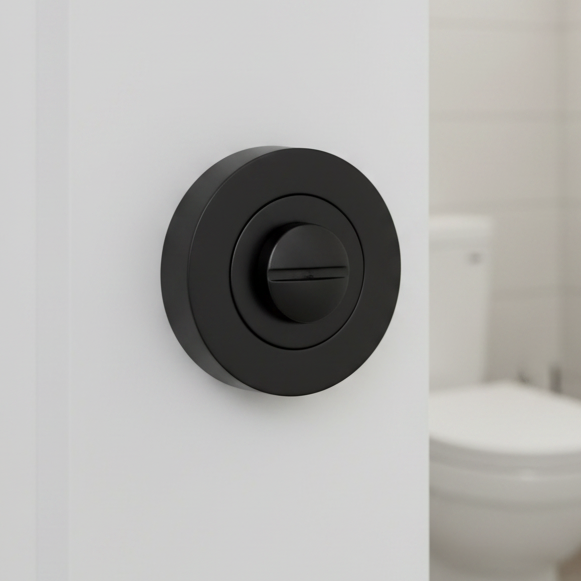
If you choose a lever on rose for the rest of the house, a separate circular privacy turn can keep the bathroom door consistent. The Nero JMB2666 Matt Black Turn and Release has a 50mm circular form, allowing it to sit beneath a similarly proportioned lever rose.

This creates two small black circles on the white door rather than one large bathroom backplate. If you prefer a more substantial fitting, browse our matt black bathroom door handles for integrated backplate designs.

Think room by room, but keep the view between rooms consistent

A black handle can play a slightly different role in each area of the home. The aim is not necessarily to decorate every room in the same way, but to make the doors feel connected when they are seen together.

Hallway

Choose a shape that remains calm when repeated. A straight or gently tapered lever can create a tidy rhythm across several white doors.

Kitchen

Relate the handle to black window frames, taps or cabinet pulls, but leave enough white and timber visible to prevent the room becoming too graphic.

Bedroom

A softly curved or rounded black handle can sit more comfortably with upholstered furniture, warm lighting and relaxed neutral fabrics than an especially sharp design.

Bathroom

Use the door handle to echo black shower framing, taps or mirror edging, then select the appropriate privacy lock or turn for the door.

Home office

Straight, square-section and tapered handles work well alongside shelving, desks, task lighting and more architectural furniture.

Alignment matters more when the hardware is black

Black fittings show their outline clearly, so small installation differences can be easier to notice. A lever that is not level, a rose positioned slightly off-centre or a backplate that does not align with the door panels may stand out more against white than it would in a lower-contrast finish.

This does not make black hardware difficult to use, but it rewards careful preparation. Measure consistently across a group of doors, check that each lever sits level and make sure the selected backplate or rose fits comfortably on the door stile.

Check these four things before drilling

  1. Handle height: establish one consistent level across doors that can be viewed together.
  2. Panel position: make sure the rose or plate is not uncomfortably close to moulded edges.
  3. Stile width: confirm there is enough timber for the fitting, latch and fixings.
  4. Door swing: check that the lever will not strike an adjacent wall, cupboard handle or another open door.

Replacing an existing long backplate with a small rose

A compact black lever on rose can look excellent on a newly painted white door, but it may not cover marks left by the previous hardware. Before choosing a much smaller fitting, remove or loosen the old handle and inspect the door beneath it.

Old screw holes, compressed paint, faded areas or the outline of a long backplate may remain visible beyond the new rose. If the door is being filled, prepared and repainted, that is normally manageable. If you are hoping for a direct handle change without redecorating, selecting a backplate of similar or greater size may produce a neater result.

Complete the edge of the door as well as the face

When the door is closed, the handle receives most of the attention. When it is open, the hinges, latch faceplate and strike plate become visible against the white paint. Deciding whether those parts should also be black depends on how complete you want the contrast to feel.

Plan the whole door

A coordinated pack can simplify a new-door project

The Belas Matt Black Door Handle Pack combines a pair of lever-on-rose handles with a tubular latch and black hinges.

This type of set can be useful when fitting new or replacement internal doors because the main visible components have already been brought together in one finish.

Always check that the included hinge, latch and handle specifications are suitable for the particular door, especially where fire-door performance, door weight or unusual dimensions need to be considered.

Browse door handle and latch packs

If you are selecting the parts individually, browse black butt hinges and check the relevant product information for load, dimensions and door suitability. The hinge should be chosen for its performance first; colour coordination is the finishing consideration.

Should the hinges be black on a white door?

They do not have to be. Black hinges create a clear repeated detail along the edge of an open white door and can make the installation feel more fully coordinated. They are particularly noticeable on doors that remain open for long periods.

A neutral metal hinge may be less visually prominent when the door is open, especially if it relates to other existing hardware in the property. The best decision depends on whether you want every operational part to contribute to the black-and-white look or whether the handle should remain the main dark feature.

Whichever direction you choose, use a hinge type and grade appropriate for the door. Do not select a hinge purely because the finish matches the handle.

Black hardware does not require a black-and-white room

One of the strengths of this combination is that the white door and black handle can provide structure while the rest of the interior remains warm and colourful.

Natural oak flooring, tan leather, olive upholstery, woven rugs and warm neutral walls can all sit beside black-on-white doors. The contrast acts as an outline around the functional parts of the room rather than dictating the entire colour palette.

This is often more comfortable than extending black onto every piece of furniture. A small number of clear black accents generally looks more deliberate than scattering many unrelated dark objects around the room.

Know when to stop

Once black appears on the door handles, a few additional references are usually enough. Black-framed glazing, selected cabinet handles or one light fitting may complete the connection.

There is no need to replace every socket, switch, hinge, tap and accessory unless a fully monochrome interior is genuinely the design intention. Giving the black details some clear space around them often makes each one look stronger.

Will matt black handles show fingerprints?

A matt finish is generally less reflective than a polished black surface, which can help everyday marks appear less obvious. However, any frequently touched handle will eventually collect oils, dust and residue from hands.

Clean the hardware gently with a soft, lightly dampened cloth and dry it afterwards. Avoid abrasive pads, harsh chemicals and aggressive cleaners that could scratch or damage the applied finish. Follow any care guidance provided for the individual product.

Do black handles make white doors look too stark?

They can create a strong contrast, but the result does not have to feel cold. Using a warmer white, natural timber flooring, soft furnishings and warm-toned lighting will reduce the severity without weakening the black outline.

The handle shape also matters. A straight square lever feels sharper, while a rounded or gently curved lever introduces a softer character. If you like the finish but are unsure about the starkness, start by comparing shapes rather than abandoning black completely.

Are black handles suitable for traditional white panelled doors?

Yes. A white panelled door can support black hardware very well, particularly in homes that mix classic architecture with contemporary decoration.

For a softer transitional look, consider a curved lever or a long backplate with gently shaped ends. For a stronger modern contrast, use a simple lever on rose. The existing door mouldings will continue to provide the traditional character even when the hardware is contemporary.

Should every internal door use the same black handle?

Using one handle design throughout creates the strongest sense of continuity, especially where several doors are visible from one position. It is not the only option, however.

You can use different functions from the same family — latch, lock and bathroom versions — or keep the matt black finish consistent while varying the design in more private or architecturally different areas. For example, a long-backplate handle might suit original panelled doors while a lever on rose is used on flush doors in a new extension.

The variation should relate to a clear reason such as door style, room function or architectural zone rather than changing randomly from room to room.

Can black handles work on cream doors?

Yes. Black against cream or ivory feels warmer and less graphic than black against brilliant white. It works particularly well with natural timber, stone, beige, olive and other earthy colours.

The door will still read as light and the handle will remain clearly defined, but the overall interior can feel softer and more relaxed.

Create a clearer outline

Find the black handle that suits your white doors

Start with the door rather than the finish. Look at its panels, proportions and position within the room, then decide whether the hardware should create a fine horizontal line, a softer curve, a textured detail or a strong vertical backplate.

Shop Matt Black Door Handles Explore Black Door Furniture

Browse our complete collection of matt black internal door handles, compare minimalist designs in the black lever-on-rose collection, or return to our door handle inspiration pages for more ideas on coordinating door hardware with the colours, materials and architecture around your home.