Black Knurled Door Handle Ideas & Inspiration

Black knurled door handles are at their best when they form part of a wider design idea. The matt black finish gives the hardware a strong architectural outline, while the knurled sections introduce fine detail that only becomes obvious as you move closer to the door. That combination makes them particularly useful in modern interiors where the larger shapes are simple but the smaller details have been carefully considered.

Rather than thinking of a knurled handle as an isolated feature, consider how the same visual language could move through the home. A compact lever can suit an ordinary internal door, a long backplate can give a bathroom or study door more presence, and a larger knurled pull can pick up the same idea on a glazed door, wardrobe or substantial timber door. The fittings do not have to be identical to feel related. Browse our black knurled door handles as you explore the ideas below.

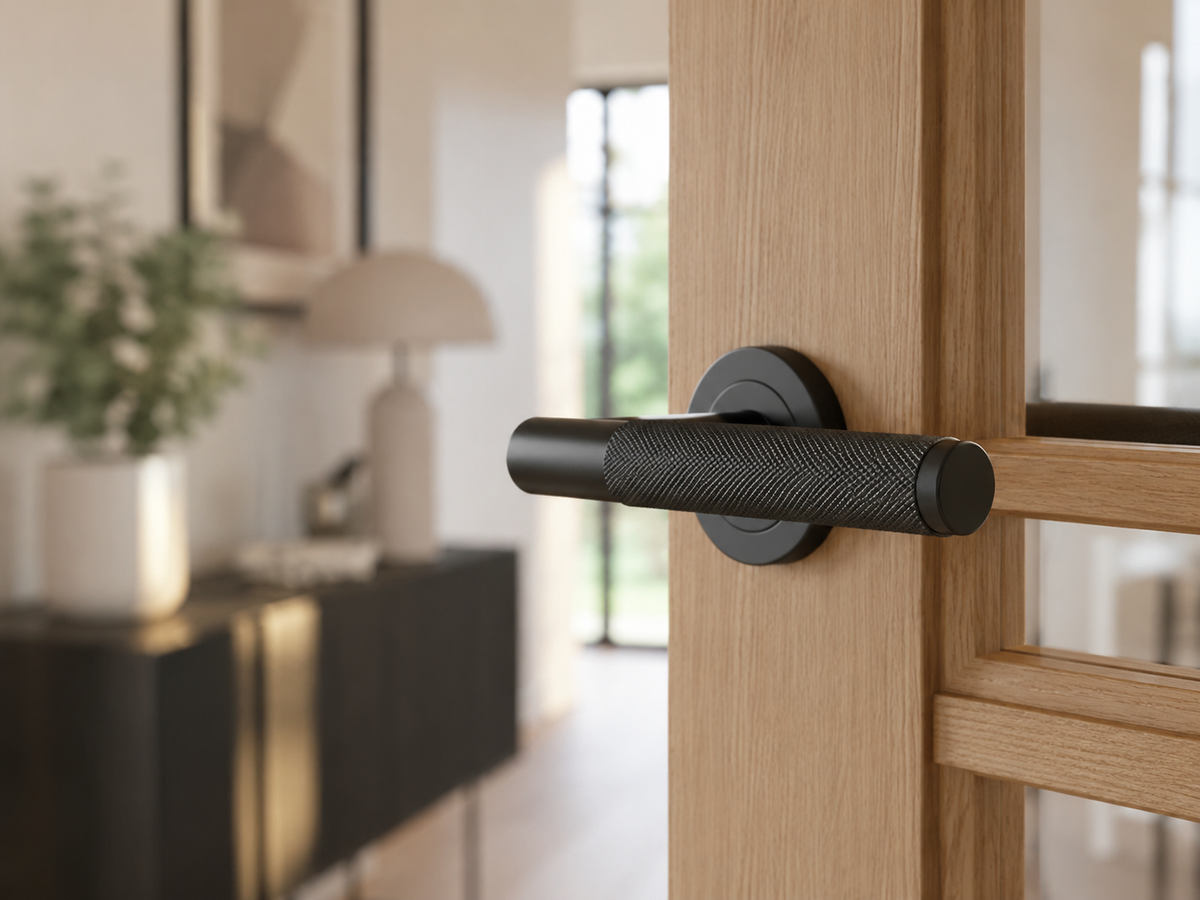
The Nero JMB400 Matt Black Knurled Lever on Rose keeps the overall form simple, allowing the patterned grip to provide the finer detail.

The design approach

Create a family of details, not a house full of identical handles

A well-planned interior often repeats an idea rather than a product. Black knurling can become that repeated idea. The diameter, length, backplate and function can change from one opening to another, while the combination of matt black and fine machined texture keeps everything visually connected.

This gives you more freedom than specifying one handle everywhere. A bedroom door, bathroom door, glazed kitchen door and tall cupboard do different jobs, so there is no reason their hardware has to be physically identical.

Start with the ordinary internal doors

The everyday doors usually establish the hardware language for the rest of the house. Bedrooms, living rooms, offices and hallways tend to need relatively compact fittings, so a lever on rose is an easy starting point.

The Nero JMB400 uses a straight cylindrical grip with diamond knurling and a circular rose. From across a hallway, the handle reads primarily as a clean black horizontal line. At closer range, the patterned grip becomes much more apparent.

That two-scale effect is useful in contemporary homes. The architecture can remain calm and uncluttered while individual fittings still have enough detail to avoid looking generic.

01 From the hallway You mainly see the black silhouette and the repeated position of each lever.
02 At the doorway The cylindrical proportions and matt surface become more noticeable.
03 In the hand The knurled pattern becomes the detail you actually interact with.

Let different door types change the hardware

A house with only one type of internal door is relatively straightforward. Many modern renovations are more varied: solid doors lead to bedrooms, glazed doors divide kitchens and hallways, sliding or oversized doors appear in open-plan areas, and fitted joinery may sit only a metre or two away.

Rather than trying to force one handle onto all of those surfaces, keep the design DNA consistent and change the format.

Glazed doors

Black gives timber and glass a useful outline

Glazed internal doors already contain strong lines created by the timber frame and glass divisions. A black cylindrical lever can become another one of those lines rather than introducing a different decorative language.

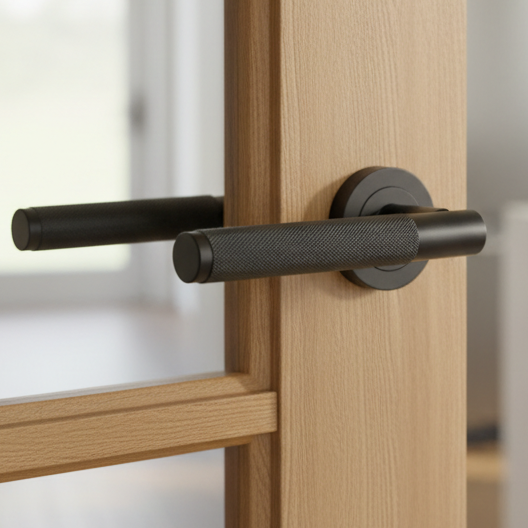
The Bari Black Knurled Lever on Rose works particularly well here because its rose is compact and the T-bar-style lever has a simple rounded section.

Against natural oak, the black finish provides definition without hiding the grain. Against painted glazing bars, the same handle can relate directly to black-framed glass elsewhere in the interior.

Interior idea: oak glazed door + black knurled lever + pale limestone floor + off-white walls + one or two black lighting details.

Black knurling does not need an industrial interior

The machining and dark finish can certainly suit industrial-inspired spaces, but limiting the look to exposed brick and concrete misses much of its potential. Black knurled hardware can be equally convincing in warm, highly finished interiors.


Natural oak

Warm timber keeps the black hardware from feeling cold. The combination works especially well where the room also contains cream, stone and woven materials.


Putty & greige

A softer alternative to pure white. Black remains clearly visible while the overall scheme feels calmer and more residential.


Microcement & stone

Mineral surfaces suit the precision of knurled metal particularly well, especially in contemporary bathrooms and kitchen spaces.


Dark joinery

Black-on-black creates a quieter effect. Here the texture and changing light across the grip become more important than colour contrast.

Think in zones rather than individual rooms

One useful way to specify hardware across a renovation is to divide the home into zones. Each zone can use the form of hardware that makes sense there, while the black knurled detail keeps them related.

Private rooms

Bedrooms, offices and ordinary internal doors can use a compact knurled lever on rose. This keeps the hardware visually light where several doors may appear together.

Service rooms

Bathrooms, utility rooms and rooms that need locking can use a long-backplate version where the additional function becomes part of one stronger piece of hardware.

Feature openings

Large glazed, pantry or statement doors can take a longer pull handle, allowing the same black knurled idea to increase in scale with the opening.

Fitted furniture

Wardrobes and cabinetry can repeat a smaller amount of knurled black detail, linking furniture to the architecture without requiring an exact miniature version of the door lever.

When a long backplate makes more sense

A lever on rose is deliberately compact. Sometimes a door needs more visual weight. Tall panelled doors, hotel-style bedrooms and doors positioned within substantial fitted joinery can comfortably take a longer vertical plate.

More presence

The Connaught changes the proportion

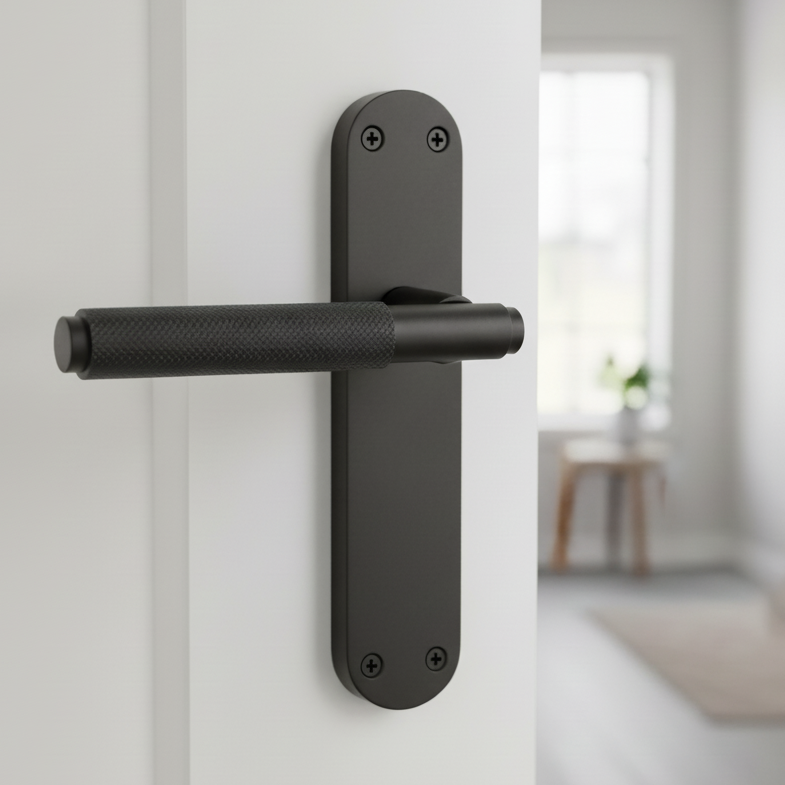
The Connaught Matt Black Knurled Latch Handle combines the cylindrical textured grip with a tall rounded backplate.

That plate creates a vertical line behind the lever, making the complete fitting substantially more visible than a small circular rose. It is a useful option when a compact handle feels visually lost on the door.

Because the lever remains relatively simple, the backplate changes the scale without making the design ornamental. This can suit tall internal doors, deeper moulded panels and interiors where black details have a stronger architectural role.

Explore Matt Black Connaught Handles

Rose or long plate? Look at the empty space around the handle

A useful way to choose between the two is to ignore the handle for a moment and look at the door surface around it.

If the door has clean proportions, narrow stiles, glazing or attractive grain that you want to leave visible, a compact rose allows more negative space around the fitting.

If there is a broad uninterrupted stile, a tall plain door or a large panel surrounding the handle position, a longer backplate can occupy that space more confidently.

Neither format is automatically more contemporary. What matters is whether the size of the hardware feels proportionate to the architecture it sits on.

Take the idea up in scale for feature doors

One of the most effective aspects of a knurled hardware scheme is that the same texture can move from a hand-sized lever to a much longer pull.

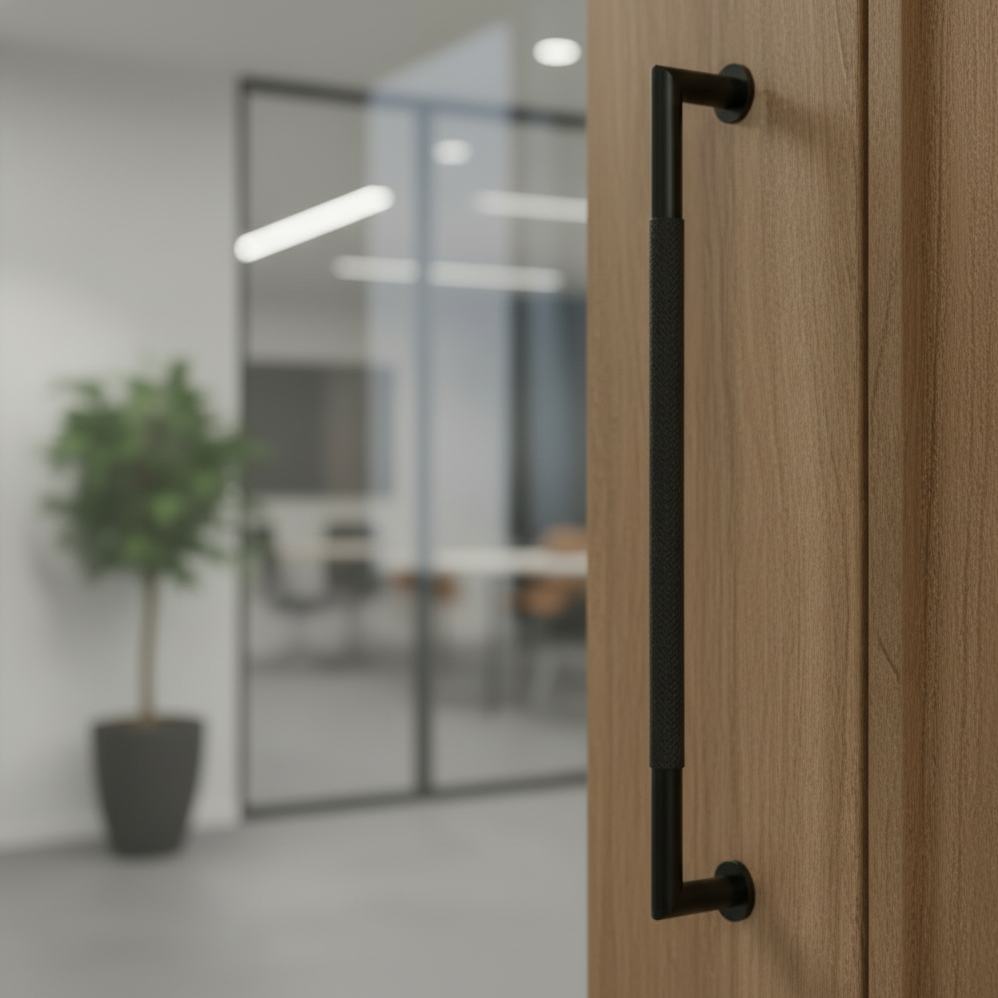
A long pull uses the same combination of smooth black sections and tactile knurling at a very different scale. Shown: Nero JMB8 Matt Black Knurled Pull Handle.

The Nero JMB8 Matt Black Mitred Knurled Pull Handle is 443mm overall, so it creates a much more substantial vertical element than a conventional lever. Its knurled central section allows the texture to remain recognisable even though the proportions have changed completely.

This kind of fitting can make sense on large timber or glazed doors where a standard lever would look under-scaled, or on doors designed to operate with a pull rather than a conventional latch lever. Always choose the hardware according to the door mechanism and installation requirements rather than substituting a pull handle purely for appearance.

Pantry door A long black pull can become a feature against oak, painted cabinetry or fluted panels.
Glazed opening The vertical pull can echo dark glazing bars and nearby metal framing.
Tall cupboard Larger-scale hardware can suit full-height storage better than a small cabinet knob.
Feature timber door The black vertical line provides strong contrast while leaving most of the wood visible.

The strongest partner may be fluted glass, not another black object

Knurled metal contains hundreds of very small repeating lines. That makes it particularly interesting alongside materials that also change as light moves across them.

Fluted or reeded glass is an obvious example. The glass has a larger vertical rhythm while the handle carries much finer cross-hatched detail. The two textures relate without looking matched.

The same principle applies to ribbed timber cabinetry, slatted wall panels, boucle upholstery and softly veined stone. These materials give the eye something to discover at close range while allowing the overall colour scheme to remain relatively simple.

A useful styling rule: pair fine knurling with one or two larger-scale textures. Avoid surrounding it with lots of tiny competing patterns.

Oak and black knurling create a particularly useful modern combination

Natural oak is warm, varied and visibly organic. Matt black hardware is controlled and precise. Putting them together gives each material something the other lacks.

Warm surface, precise hardware

Use black knurled hardware with oak if you want a contemporary scheme that still feels warm. The grain prevents the black fittings from dominating, while the dark hardware gives the timber more definition.

It can work particularly well with pale walls, off-white ceilings, limestone tones and soft fabrics. You get the clarity associated with black hardware without relying on a stark black-and-white palette.

For a more dramatic variation, use the same hardware against smoked or darker stained oak. The colour contrast becomes lower, making the knurling and silhouette more important.

One small metallic contrast can change the mood

Black knurled hardware does not always need to be completely black. Introducing a small amount of satin metal can make the fitting feel more technical and deliberately engineered.

Alternative detail

Break the black with a satin collar

The Nero JMB105 T-Bar Knurled Lever introduces a contrasting satin stainless-steel section between the black rose and knurled grip.

That small change gives the fitting a more mechanical character and can make sense in kitchens or contemporary rooms where stainless-steel appliances, metal shelving or brushed-metal details are already present.

It is a good example of why coordinating hardware does not mean everything has to be one uninterrupted colour.

Make the bathroom door part of the scheme, not an exception

Bathroom doors often disrupt an otherwise consistent hardware scheme because they need a privacy function. One option is to use a related knurled handle where the lock control is incorporated into the backplate.

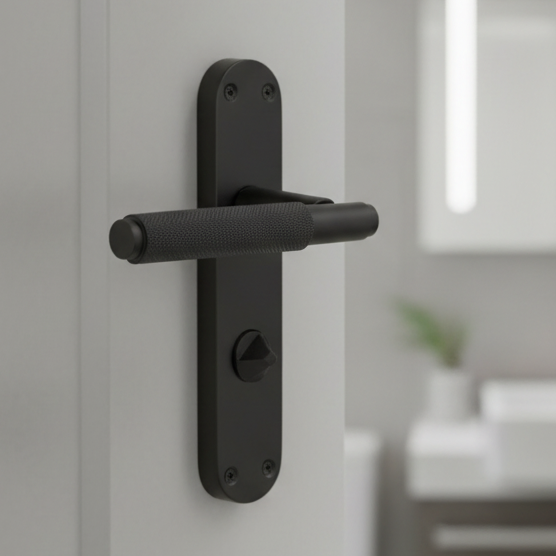
The Connaught Matt Black Knurled Bathroom Door Handle keeps the textured cylindrical lever but adds an integrated privacy turn to the long plate. It therefore remains recognisably part of the same design family while serving a different function.

This can be especially useful when a bathroom door is visible from a hallway containing several black handles. Rather than switching to unrelated hardware simply because the door needs privacy, the visual idea continues through.

Use it with the appropriate bathroom mortice lock, and always check the individual product information before preparing the door. You can also browse the wider range of black bathroom door handles if you want to compare other locking formats.

Repeat knurling on cabinetry selectively

A kitchen or fitted bedroom presents an obvious temptation: once you have chosen a knurled door handle, put knurling on every drawer and cupboard as well. That can work, but it is not always the most sophisticated solution.

Instead, consider repeating the detail only on the pieces that matter most. A tall pantry cabinet, integrated fridge surround, wardrobe or bank of large drawers can carry textured hardware, while secondary cupboards use simpler black knobs or pulls.

The Hoxton Thaxted Line Knurled Cabinet Handle is available in matt black and uses knurled end details rather than covering the entire handle in texture. The Hoxton Taplow Knurled Cabinet Handle provides another option where the textured detail is more prominent.

Cabinetry strategy

Use a hierarchy

Door handles Primary knurled detail throughout the room.
Tall cabinets Repeat the texture on larger handles.
Small drawers Simpler black hardware can provide a quieter layer.
Hidden storage Push-to-open or discreet pulls can prevent visual overload.

How much knurling do you actually want?

Not all textured black handles make the same visual statement. Before choosing, decide how much of the fitting you want the pattern to occupy.

SUBTLE
Knurled accents only
Choose hardware where texture appears on an end cap, collar or limited grip area. Useful when the room already contains plenty of detail.
BALANCED
Full textured grip
The lever remains straightforward, but most of the part held by the hand carries the knurled pattern. Nero JMB400 and Bari sit naturally in this territory.
STRONG
Large-scale textured pull
Increase the overall size of the hardware so the knurled area becomes an architectural feature rather than simply a lever detail.

Use lighting to reveal the hardware rather than spotlight it

Matt black absorbs light, so the fine pattern is often easiest to appreciate when light travels across the grip from one side. This does not require dedicated lighting for the handle. Ordinary daylight from an adjacent window, a hallway wall light or a pendant positioned further along the room can be enough.

In very dark interiors, a black knurled handle can almost disappear from a distance. That may be exactly the effect you want. Here, the fitting becomes less about contrast and more about the way its surface changes as you approach it.

On lighter doors and timber, the outline remains visible even in relatively flat light, so you get both the black silhouette and the finer surface detail.

When black knurled hardware may be the wrong choice

A strong design idea also benefits from knowing where not to use it. Knurled black hardware may not be the best answer if the door already contains a great deal of carved decoration, ornate glazing or numerous competing fittings.

Likewise, if your interior deliberately uses very soft traditional hardware throughout, a sharply machined cylindrical lever may feel disconnected unless there are other contemporary elements nearby.

It is also worth considering cleaning requirements in rooms exposed to building dust, plaster or heavy renovation debris. The fine pattern can hold residue more readily than a completely smooth surface, so protect installed handles properly while other work continues.

A black knurled scheme that does not feel over-designed

Internal doors: compact black knurled lever on rose.

Bathroom: related long-plate knurled handle with privacy function.

Glazed kitchen door: black knurled lever against oak or painted timber framing.

Pantry or tall feature door: longer knurled pull handle.

Cabinetry: knurled pulls on selected large doors, simpler black hardware elsewhere.

Other visible door furniture: keep hinges, stops and secondary accessories relatively simple so the textured touch points remain the feature.

Coordinate the surrounding black door furniture

Once the main handles are chosen, look at the other pieces that will remain visible. Black hinges, escutcheons, door stops, flush bolts and related accessories can continue the dark hardware line without needing to repeat the knurling.

The Matt Black Nero Door Furniture & Accessories collection includes coordinating black components that can sit alongside the knurled Nero handles and pulls.

This is where restraint is useful. A smooth black hinge beside a knurled black lever still reads as coordinated. Trying to make every small component textured would add complexity without necessarily improving the finished door.

Plan the hardware before the doors are fitted

If you are combining levers, long plates and pull handles within one project, make those decisions while the door schedule is still being planned. The different fittings can require different lock, latch, fixing and preparation arrangements.

A standard lever operating a tubular latch is not the same installation as a large bolt-through pull handle, and a bathroom backplate requires the appropriate privacy lock behind it. Glazed and narrow-stile doors also need enough suitable material around the hardware position.

Planning those requirements at the same time as the doors makes it much easier to achieve the visual consistency you want without compromising how each door needs to function.

One detail, several scales

Build your black knurled hardware scheme

Start with the doors you use every day, then let the hardware change scale and format as the openings change. The aim is not to make every fitting identical; it is to create enough repetition that a lever, bathroom handle and long pull all feel as though they belong to the same interior.

Shop Black Knurled Door Handles Explore All Knurled Handles

Browse our black knurled door handle collection, explore coordinating matt black door furniture for the finishing details, or return to our door handle inspiration pages for more ways to use colour, shape, material and hardware as part of the wider interior.