Modern Antique Brass Door Handle Ideas & Inspiration
Modern interiors do not have to be filled with cool chrome, stainless steel or black hardware. Antique brass can bring warmth into a contemporary room without making it feel traditional — provided the shape of the handle is kept clean, well proportioned and relatively simple.
This is where modern antique brass door handles become particularly interesting. The finish has depth and softness, while the lever itself can still be crisp, architectural and minimal. Against plain painted doors, contemporary panelling, pale oak, fluted glass and understated neutral interiors, antique brass acts as a warm detail rather than a period statement. Browse our antique brass lever on rose handles if you already know that a cleaner, compact fitting is the direction you prefer.

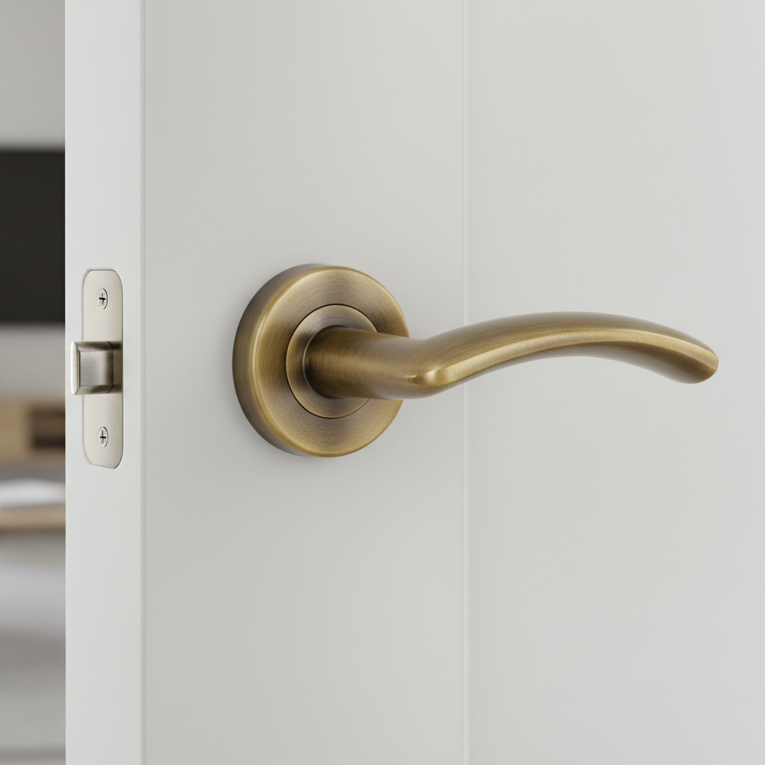
A simple door and compact round rose allow the curved lever to become the feature. Shown: Heritage Centaur Antique Brass Lever on Rose.
The modern brief
Warm metal. Clean outline. Nothing unnecessary.
What actually makes an antique brass handle look modern?
The word antique describes the appearance of the finish, not necessarily the design of the handle. An aged brass tone can be applied to a very simple contemporary lever just as easily as it can to an ornate traditional one.
For a more modern result, pay attention to the silhouette before the finish. Long uninterrupted lines, compact roses, concealed fixings, tapered levers and uncomplicated curves all reduce visual clutter. The antique brass then brings warmth and variation to that simple form.
This is especially effective in rooms that might otherwise feel a little too crisp. White plaster, large-format tiles, smooth cabinetry, simple moulded doors and pale flooring all benefit from one or two elements that have more visual depth. Antique brass supplies that depth without requiring another colour or pattern.
Think of the finish and the shape separately. If you want a modern interior, choose the lever for its proportions first. Let antique brass provide the warmth afterwards.
The cleanest option: a lever on rose
A long backplate can be an important part of a handle's character. For a more minimal look, however, a lever on rose removes most of that visible metal and leaves the door surface relatively clear.
The result is particularly effective on flush doors and modern panelled doors because the eye reads the lever almost as a line floating against the door. When a separate locking function is needed, an escutcheon or privacy turn can be positioned beneath the handle rather than being incorporated into one large plate.
Sharp profile
Use taper to make the handle feel lighter
The Geo Tapered Antique Brass Door Handle demonstrates a useful contemporary principle. The lever begins with more visual weight close to the rose and gradually narrows towards the end.
That taper stops a 134mm lever from appearing bulky. It gives the handle a clear direction and a more architectural character, particularly on plain doors where there is little other decoration.
The 50mm circular rose is also relatively compact, helping the handle sit neatly against the door rather than covering a large area around the spindle.
Five details that change the character of a modern handle
How straight is the lever?
A straight lever usually feels more architectural. A controlled curve softens the appearance without necessarily making it traditional. The important distinction is between a purposeful curve and decorative scrollwork.
How much metal surrounds it?
A small round rose makes the lever itself more prominent. Larger or stepped roses create more visual weight and can be useful if the door is substantial enough to carry it.
What happens at the end?
A sharply cut end feels different from a rounded end. Fine rings, tapering or a subtle change in section can add interest while keeping the overall handle simple.
How far does it project?
Projection changes the visual weight as well as the feel in the hand. It is worth checking this dimension carefully where doors sit close to walls, furniture or another opening door.
How visible are the fixings?
Concealed-fix roses give the finished door a cleaner face. When you are aiming for a minimal interior, removing small visual distractions makes more difference than you might expect.
Modern does not have to mean perfectly straight
The Centaur approach: one continuous curve
Contemporary hardware can still have softness. The Centaur Antique Brass Lever on Rose uses a smooth 114mm curved lever mounted on a 53mm round rose.
There are no knurled sections, ornate ends or decorative backplate details. Instead, the curve itself creates the shape. This is useful in rooms containing rounded furniture, curved lighting, arched mirrors or other softer forms.
It is also a reminder that a contemporary interior does not need every fitting to be square and angular. Mixing controlled curves with clean architecture can make a room feel less rigid.
Match the handle to the architecture of the door
When the hardware is simple, the relationship between handle and door becomes more noticeable. Instead of choosing a handle in isolation, look at the lines already present in the door.
Door type 01
Flush doors
With no panels or mouldings to compete with the hardware, even small differences in lever shape become obvious. A tapered or straight handle on a compact rose works particularly well.
Try: Geo or Alicia.
Door type 02
Simple panelled doors
A panelled door can still feel modern when the mouldings are restrained. A rounded rose often sits neatly within the geometry without adding another large rectangular shape.
Try: Centaur or Sophia.
Door type 03
Glazed & narrow-stile doors
Here, scale matters. Check the width of the timber stile around the glass before ordering, allowing enough room for the rose, handle movement and the lock or latch inside the door.
Look for: compact roses and uncomplicated lever shapes.
Aged brass can soften a very pale interior
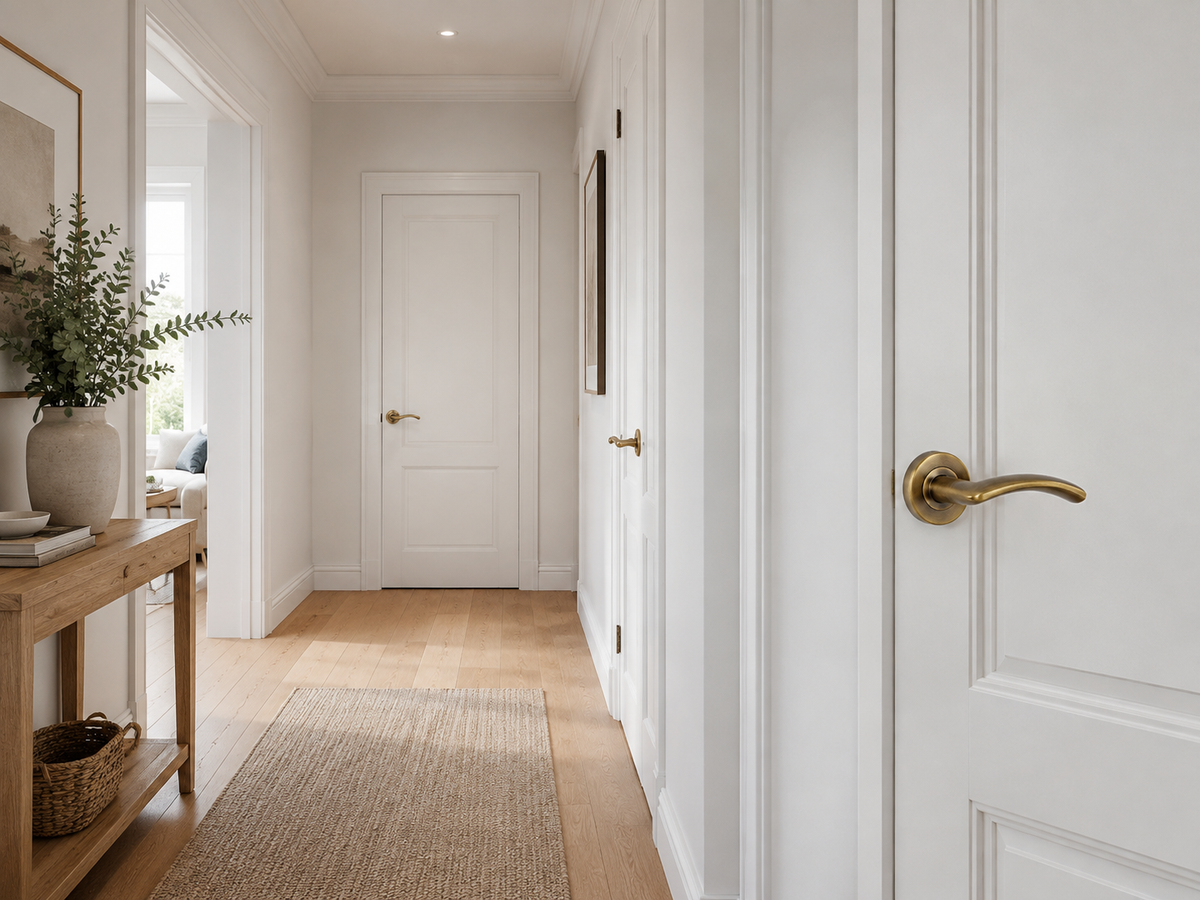
On white, warm grey, putty and off-white doors, antique brass creates definition without producing the graphic contrast of matt black. The handle is easy to see, but the transition between door and hardware feels gentler.
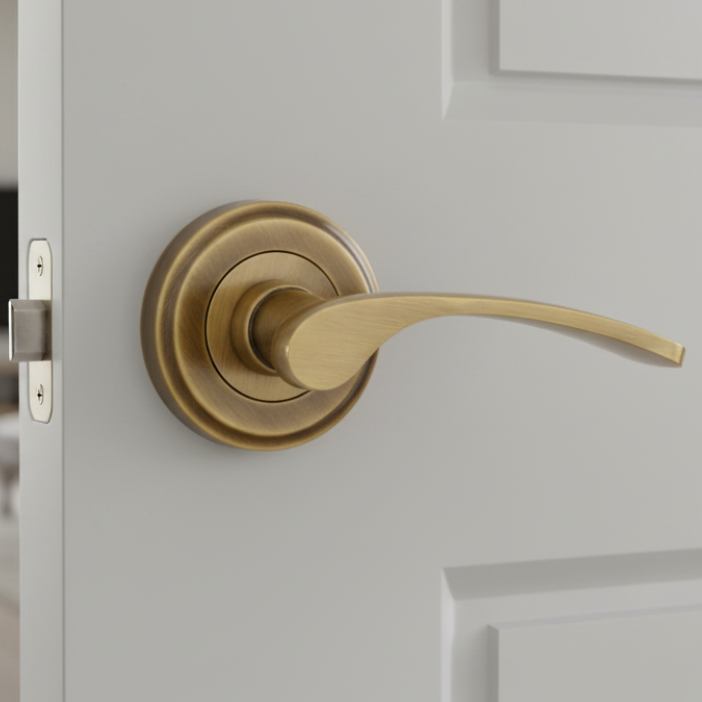
The Sophia Antique Brass Lever on Rose is a good example. Its gently curved lever and stepped circular rose bring enough shape to a plain light door while still leaving the overall door relatively uncluttered.
Choose your level of contrast
There is more than one way to make antique brass feel contemporary. One of the simplest decisions is how strongly you want the hardware to stand away from the door.
Soft taupe, mushroom, stone and beige allow antique brass to blend into the room. This creates a quiet, tonal look.
The handle is clearly visible but does not dominate. This is one of the easiest combinations to use in a modern renovation.
Dark doors make the warmer areas of the brass much more visible. Use this when you want the handle to act as an intentional accent.
A straight handle does not have to feel severe
Small detail, otherwise simple
The Alicia Antique Brass Lever on Rose takes a different approach from the Centaur. The 124mm lever is considerably straighter, but three narrow rings towards the end introduce just enough decoration to stop the design feeling completely plain.
This type of handle can be useful in contemporary interiors where everything else is intentionally restrained. A tiny amount of repeated detail often gives the hardware more character than choosing an elaborate shape.
It would sit comfortably with slim-profile furniture, simple joinery, ribbed glass, linear lighting and understated cabinetry.
Modern renovation idea
Keep the old house. Lose the reproduction hardware.
A period property does not have to be furnished as a period interior. If original proportions, cornicing, fireplaces or panelled doors already provide plenty of architectural character, contemporary antique brass handles can create a useful bridge between old and new.
The finish acknowledges the warmth and age of the building, while a cleaner lever prevents the refurbishment becoming overly themed. This approach works especially well when historic rooms are being combined with modern kitchens, contemporary bathrooms or simpler new joinery.
In other words, you can respect the architecture without trying to recreate every fitting that might once have been there.
Let separate fittings preserve the minimal look
One advantage of lever-on-rose handles is that a door only has to show the hardware it actually needs. A living-room door can have just the lever and rose. If a study or bedroom requires a key, a separate escutcheon can be introduced below it. A bathroom can use a separate turn and emergency release.
This creates more space between each element than a long combined backplate, which can be useful when the design aim is simplicity.
Build the bathroom hardware in separate pieces
The Heritage V4035 Antique Brass Turn & Release has a 53mm circular form designed to sit with lever-on-rose handles and a suitable bathroom lock or bolt.
Keeping the privacy control separate allows you to maintain the same compact-hardware language rather than switching to a completely different style of bathroom handle.
For key-locking doors, browse antique brass escutcheons to achieve a similar effect around the keyhole.
Four modern antique brass personalities
“Modern” is broad. Before choosing a handle, decide what kind of contemporary look you actually want. These four directions produce noticeably different results even though the finish remains antique brass.
| Handle | Visual character | Good with | Key feature |
|---|---|---|---|
| Geo | Sharp & architectural | Flush doors, modern apartments, clean joinery | Flat tapered lever |
| Centaur | Soft & sculptural | Curved furniture, neutral schemes, panelled doors | Smooth sweeping curve |
| Alicia | Linear with detail | Home offices, fitted cabinetry, contemporary renovations | Straight lever with ringed end detail |
| Sophia | Relaxed & transitional | Light painted doors, softer contemporary rooms | Gentle curve and stepped rose |
A modern handle should suit the scale of the door
Minimal hardware does not mean tiny hardware. A very small lever can look lost on a tall or unusually wide door, while an oversized fitting can dominate a narrow glazed stile. Always check the published dimensions rather than judging size purely from photography.
For comparison, the Geo has a 134mm lever on a 50mm rose, the Centaur uses a 114mm lever on a 53mm rose, the Alicia has a 124mm lever on a 53mm rose, and the Sophia combines a 109mm lever with a 53mm rose.
Those differences may sound modest, but they affect how far the handle travels visually across the face of the door. If you are specifying a number of identical doors, it can be worthwhile marking the approximate rose and lever dimensions onto one door before ordering the complete set.
The “less, but better” checklist
Does the lever have one clear design idea?
A taper, a smooth curve or a small detail is often enough.
Is the rose proportionate to the door?
Compact hardware looks best when it still has enough visual presence to suit the door.
Do you actually need a keyhole or privacy fitting?
Only add hardware where the function of the room requires it.
Are you repeating antique brass deliberately?
A few consistent references generally feel more sophisticated than using the same finish on every object.
Have you checked what is already drilled into the door?
When replacing existing handles, a compact rose may not hide old fixing holes or marks left by a larger backplate.
What should antique brass coordinate with in a modern room?
It does not need an exact partner. In fact, one of the most effective ways to use antique brass in a contemporary interior is to allow it to be the warmest metal in the space.
A room might contain black window frames, dark bronze light fittings or stainless-steel appliances without requiring the door handle to match them. What matters more is repetition and spacing. If antique brass appears on every internal door, that repeated use is enough to establish it as a deliberate part of the design.
Where you do want a closer relationship, repeat the finish on something small: a few cabinet handles, a lamp detail, selected hooks or a bathroom accessory. Avoid feeling that every hinge, tap, light fitting and furniture leg has to become antique brass simply because the door handles are.
Use modern antique brass to warm up monochrome schemes
A room made almost entirely from white, grey, black and stone can occasionally feel flat if every fitting is also neutral. Antique brass introduces a warmer note without asking you to commit to a strong colour.
On a white door it is gentle and understated. On charcoal it becomes much more visible. Against greige and mushroom colours it can sit almost tonally within the scheme. That flexibility is one reason an aged brass finish can work across several rooms even when the door colours change.
If you are planning a wider refurbishment, our internal door trends guide explores how antique brass and other current finishes are being used with modern internal doors.
Where a modern antique brass handle works especially well
Contemporary extensions: use antique brass to soften large areas of glass, plaster, stone and new joinery.
Modernised Victorian and Edwardian homes: a useful middle ground where the architecture has age but the furniture and decoration are contemporary.
New-build houses: changing standard door hardware to a more considered lever-on-rose design can make relatively simple internal doors feel much more intentional.
Neutral bedrooms: antique brass gives beige, cream and taupe schemes a warmer point of detail without introducing a new accent colour.
Home offices: straight and tapered levers sit comfortably alongside desks, shelving and more architectural furniture.
Contemporary bathrooms: a lever-on-rose handle with a separate circular privacy turn can echo the clean forms of taps, switches and bathroom accessories.
One finish, several door designs
A modern home does not have to use an identical door in every room. You might have flush doors in a newer extension, panelled doors in the original part of the house and a glazed door between the kitchen and hallway.
Keeping the hardware finish consistent is often enough to connect them. Antique brass can act as the common thread while the doors themselves respond to the architecture of each space.
If you prefer stronger consistency, choose one lever-on-rose handle throughout and vary only the secondary fittings — plain handle for general rooms, separate escutcheon where a key is needed and a coordinating turn and release for the bathroom.
Before replacing handles with a compact modern rose
Lever-on-rose handles are ideal when you want less visible hardware, but they are not always a straight swap for existing long-backplate handles. Remove or inspect the existing fitting first and check what will remain underneath.
Old screw holes, paint outlines or indentations may extend beyond the diameter of the new rose. If the door is being redecorated as part of the project, those areas can normally be prepared before the new hardware is fitted. If you are changing the handles without refinishing the door, check the dimensions carefully before ordering.
You should also make sure that the latch or lock position is appropriate for the new handle and that the door thickness falls within any limits stated on the individual product page. For example, the Geo Antique Brass Lever on Rose is specified for doors from 35–55mm thick.
Modern warmth
Choose the shape first. Then enjoy the finish.
The easiest way to make antique brass feel contemporary is to resist choosing by finish alone. Look for a lever with the line, scale and level of detail that suits your doors, then use the aged brass tone to introduce warmth and character into the wider interior.
Shop Antique Brass Levers on Rose Browse All Antique Brass Handles
Explore our modern antique brass lever-on-rose door handles to compare straight, tapered and curved designs, browse the complete antique brass door handle collection for more styles, or visit our door handle inspiration section for more ways to make the hardware part of your interior design.