
Best Door Handles for Rental Properties: Durability on a Budget
For a landlord, letting agent or property manager, door handles are a small purchase that can generate a surprising amount of repeat cost. They are touched constantly, pulled harder than they need to be, knocked by furniture during moves and operated by different tenants with no reason to treat them as carefully as an owner-occupier might. A handle that loosens, droops or quickly looks worn can create a maintenance visit that costs far more than the fitting itself.
That is why the best door handles for rental properties are rarely the absolute cheapest option. The better target is a robust, easily replaceable handle at a sensible mid-market price, with a finish that still looks respectable after years of everyday use. The same principle applies whether you manage one buy-to-let flat or a portfolio of houses and HMOs.
What landlords should prioritise when choosing door handles
-
Choose a finish that disguises everyday wear. Rental hardware has to cope with fingerprints, cleaning products, rings, keys and repeated contact. Satin, brushed and softly textured finishes generally hide light marking better than mirror-polished surfaces. A handle that still looks presentable without constant polishing reduces both cleaning effort and the temptation to replace it purely for appearance.
-
Prioritise mechanical simplicity. A straightforward lever with a well-supported rose or backplate is usually a safer long-term choice than an elaborate design with delicate moving parts or highly projecting decorative sections. The handle should feel substantial, return cleanly after operation and use fixings that can be tightened or replaced without dismantling half the door.
-
Check how easily the exact model can be sourced again. If one handle fails three years after a refurbishment, replacing a single matching set is cheaper than changing every handle in the hallway because the original design has disappeared. Established ranges and common finishes make future like-for-like maintenance much easier.
-
Standardise wherever practical. Using the same handle family across bedrooms, living rooms and communal areas means the maintenance team gets familiar with one fixing method, one spindle arrangement and one visual specification. Lock, latch and bathroom versions can then be chosen from the same or a closely related range where available.
-
Avoid buying solely on the lowest unit price. Saving a few pounds per door can disappear immediately if the handle loosens, the finish deteriorates quickly or a contractor has to return to replace it between tenancies. A modest step up in build quality is often cheaper over the life of the property.
-
Think about the door as well as the handle. A solid handle fitted to a weak latch, damaged screw holes or an unsuitable hollow door will still cause trouble. Check spindle size, fixing method and latch condition when handles are being replaced, particularly after repeated tenant turnover.
-
Keep the specification simple enough to repeat. A landlord-friendly handle should be easy to describe and reorder: for example, a satin stainless steel lever on rose with a standard spindle and conventional latch arrangement. The more bespoke the specification becomes, the harder it is to reproduce quickly when an urgent repair is needed.
Satin and brushed finishes usually make sense in rentals
Finish choice has a direct effect on how quickly a rental property starts to look tired. Highly polished chrome and other mirror finishes can look excellent when freshly cleaned, but they show fingerprints, smears and fine surface marks more readily. That is not necessarily a durability problem, but it does mean the hardware can appear neglected sooner.
Satin chrome, satin nickel and brushed stainless steel are often more forgiving. Their softer surface reflection disguises minor handling marks and makes day-to-day cleaning less demanding. That is useful on bedroom doors, kitchens, communal hallways and other areas where the same door handles may be operated dozens of times a day.

Stainless steel is particularly worth considering where durability and straightforward maintenance matter more than decorative effect. The stainless steel door handles range includes practical lever styles that suit modern rental interiors without looking overly commercial.
Look for handles that tolerate repeated tightening and repair
Rental handles do not only need to survive normal operation. They also need to survive maintenance. Over several tenancies, fixings may be tightened more than once, latches may be replaced and doors may be redecorated around the furniture.
A simple lever on rose or lever on backplate with accessible mechanical fixings is generally easier to maintain than a highly decorative design whose appearance depends on small trim pieces remaining perfect. Bolt-through or substantial screw fixings can also be useful where the door construction allows them, particularly on heavily used communal or shared doors.

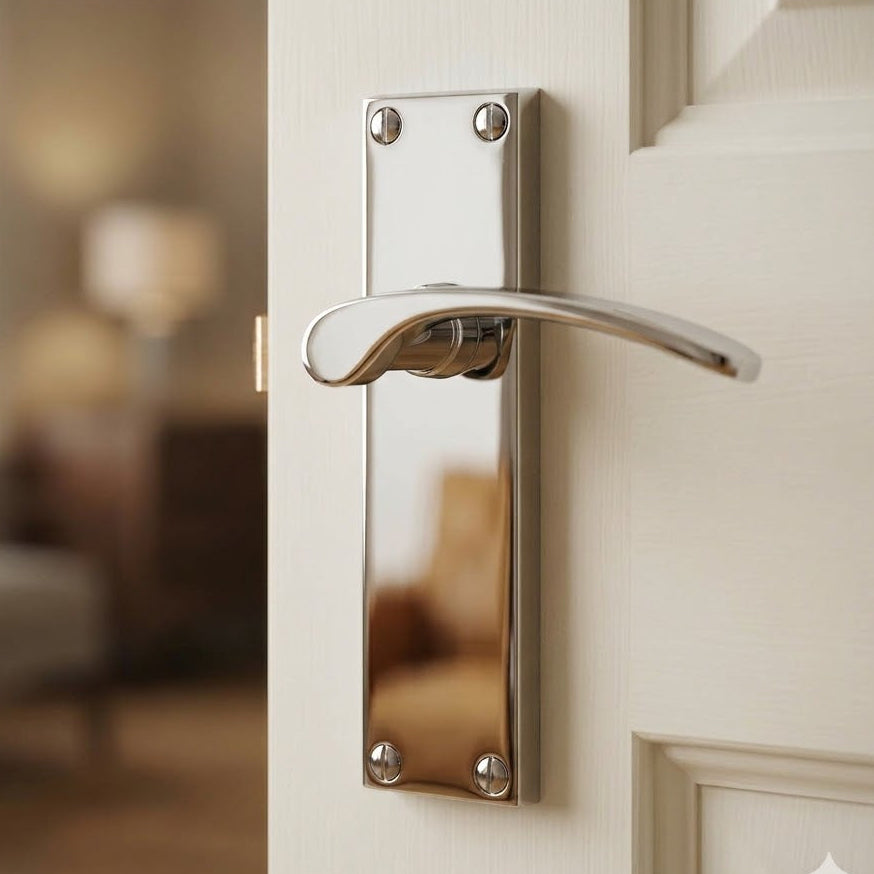
The lever on rose door handles collection is useful for landlords who want a clean, neutral fitting that can be repeated across several rooms. Where a keyhole or bathroom function needs to be incorporated into the same plate, door handles on backplate may provide the simpler specification.
Standardising one handle range saves time later
For a single rental property, matching handles create a more coherent finish. For a landlord with several properties, standardisation becomes an operational advantage.
If the same handle family is used across a portfolio, replacement stock can be held centrally rather than buying a different fitting every time a tenant reports a loose lever. Maintenance contractors know which screws, spindles and latches they are likely to encounter, and ordering replacements requires less investigation.
It also helps at changeover. If one bedroom handle is damaged immediately before new tenants move in, having an identical spare available means it can be replaced without spending time searching for something “close enough” or leaving one visibly mismatched fitting in the property.
Where several properties are refurbished at once, it can make sense to buy enough additional sets to cover predictable future replacements. The cost of holding a few spare handles is usually small compared with the labour involved in changing an entire matching run after a product has been discontinued.
Consistency also improves viewing-day presentation
Tenants may not consciously inspect the door furniture during a viewing, but they notice when a property feels well maintained. A hallway containing four different handle finishes, one loose backplate and one badly tarnished lever creates the impression that repairs have been carried out piecemeal.
Standardising the visible hardware avoids that problem without requiring expensive designer fittings. A simple satin lever repeated throughout the property can look more considered than a mixture of individually more expensive handles.
This is particularly useful in HMOs and multi-let properties, where replacement work may happen room by room over several years. Keeping one written specification prevents each maintenance visit from introducing another slightly different handle.
Avoid finishes that demand constant cosmetic attention
There is nothing inherently unsuitable about polished chrome, polished brass or dark decorative finishes in a rental. The question is whether the appearance is robust enough for the level of use and whether it still looks acceptable when it has not been polished immediately before an inspection.
High-gloss surfaces show contact marks quickly. Some darker coatings make scratches particularly visible if a contrasting base material is exposed underneath. Unlacquered brass can develop an attractive patina in an owner-occupied period house, but that changing appearance may be interpreted as tarnishing in a rental where the aim is usually predictable, low-maintenance presentation.

For especially busy shared accommodation, robustness can justify moving towards more commercial-style furniture. The key is to choose something proportionate to the property rather than specifying institutional-looking hardware everywhere simply because it is strong.
What to avoid when specifying rental property handles
Delicate designer-style levers with very thin sections, unusual moving parts or strongly projecting forms can introduce unnecessary failure points. They may be perfectly suitable in a carefully used private home but make less sense where luggage, furniture and multiple occupants regularly pass through the same doorway.
Also be cautious about obscure styles bought purely because they are temporarily discounted. If the model is difficult to identify or is already being cleared out, finding an exact replacement several years later may be impossible. Saving money at the first installation can create a matching problem at the first repair.
Very distinctive finishes deserve the same thought. A highly unusual colour can look impressive in photographs but becomes inconvenient if one handle needs replacing and the original finish is no longer available.
None of this means rental properties need to look cheap or dated. Simple satin chrome, stainless steel, black or nickel furniture can look clean and contemporary while still meeting the practical requirements of a landlord specification. Restraint and repeatability are usually more valuable than novelty.
Buy for the cost of ownership, not just the cost per pair
The useful question is not “what is the cheapest handle I can fit today?” but “what is the cheapest handle to own over several tenancies?” That calculation includes the fitting itself, contractor time, emergency visits, replacement availability and the visual cost of mismatched hardware.
A reliable mid-priced lever in a forgiving finish will often beat a bargain fitting if it stays tight, cleans easily and can still be purchased later. If one specification can cover most of a portfolio, the savings become more significant because ordering, stocking and maintenance all become simpler.
When comparing all door handles, it is worth keeping a written record of the manufacturer, product name, finish, dimensions and where each model has been installed. A photograph of the original packaging or product label can be useful as well. That small piece of record-keeping can turn a future damaged handle from a sourcing exercise into a straightforward like-for-like replacement.
