
Sprung vs Unsprung Door Handles: What's the Difference?
A sprung door handle has its own return spring built into the handle furniture, usually inside the rose or backplate. When you press the lever down, that spring helps rotate it back to the horizontal position as soon as you let go. The latch still has a spring of its own, but the handle does not have to rely on the latch spring alone to hold the lever level.
An unsprung door handle, sometimes described as a plain lever, has no return spring built into the handle itself. The lever is mechanically connected to the spindle, and the spring inside the latch or lock is responsible for returning the spindle and therefore lifting the handle back into position.
That difference is small mechanically but very noticeable when something is mismatched or worn. A relatively heavy unsprung lever fitted to a weak domestic latch may sit below horizontal even though neither component is technically broken. Equally, a sprung lever that suddenly starts hanging down may have suffered a failed spring cassette inside the rose or backplate rather than a problem with the latch.
What the spring is actually doing
Pressing a lever turns the square spindle running through the door. The spindle rotates the follower inside the latch or lock, pulling the latch bolt back into the door.
Every conventional spring latch needs some spring force to push its latch bolt back out again. That internal spring also tries to rotate the follower and spindle back to their resting position. With light unsprung furniture, that can be enough to return the handles to horizontal.
With sprung door handles, the handle furniture supplies additional return force of its own. A spring cassette or spring mechanism sits around the spindle position behind the visible rose or backplate and acts directly on the lever.

On many modern lever-on-rose designs, that mechanism is hidden completely once the decorative rose cover has been fitted. From the front, you usually cannot see whether the lever is sprung simply by looking at the finished door.
What an unsprung lever relies on instead
An unsprung lever depends much more heavily on the springing inside the latch or lock. When you release the handle, the latch spring turns the follower back, the follower turns the spindle, and the spindle raises the lever.
This arrangement can work perfectly well when the parts are correctly matched. Traditional ironmongery and heavy-duty commercial systems are often designed on exactly this basis. The problem starts when the handle needs more return force than the latch can provide.
A long or solid lever creates more leverage and may have considerably more mass than a lightweight domestic handle. If it is fitted to a lightly sprung latch, gravity can leave the handle sitting a few degrees below horizontal. That is why changing the latch can sometimes cure a drooping unsprung lever without changing the handles at all.
The weight of the door itself is not what determines whether a lever needs spring assistance. A heavy fire door does not make the handle harder to return simply because the door leaf is heavy. What matters is the lever furniture, spindle, latch or lock mechanism and the spring strength within that system.
Signs that tell you what is happening
- The lever springs sharply back when operated off the door: the handle probably contains its own return spring or spring cassette.
- The loose handle moves freely and stays wherever you leave it: it is likely to be unsprung and designed to rely on the latch or lock for return force.
- Both handles droop by roughly the same amount: the latch or lock spring may be weak, particularly with unsprung furniture.
- Only one lever droops while the other still returns correctly: a spring mechanism on that side may have failed, or the handle may be binding on its fixing plate.
- The lever returns normally until the fixing screws are tightened: alignment or overtightening may be causing the rose, backplate or spindle to bind rather than there being a spring fault.
- The lever feels loose before it begins to operate the latch: check for spindle wear, worn handle sockets or loose grub screws as well as the springing.
Why sprung handles are common on modern internal doors
For an ordinary bedroom, living-room or hallway door, sprung furniture makes installation relatively forgiving. The handle spring assists the latch, so the lever is less dependent on the latch having a particularly strong return spring.
That is useful with modern lever-on-rose furniture because some contemporary levers are fairly substantial. The built-in spring helps keep the handle visually level and gives it a more positive return after operation.
Sprung furniture also means that replacing a latch with another compatible latch of slightly different spring strength is less likely to produce an obvious change in how the lever sits.
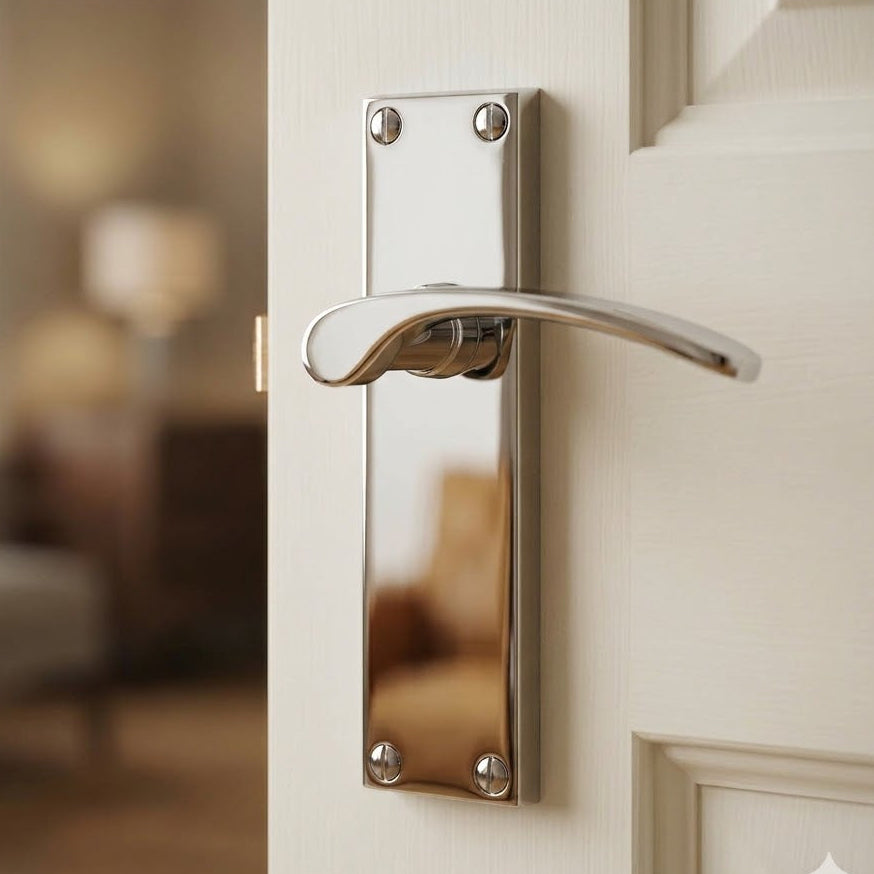
Sprung versions are available in both rose-mounted and backplate formats, so the presence of a long plate does not tell you whether the handle is sprung. If you are comparing replacements, check the product specification rather than assuming from appearance.
When unsprung handles make sense
Unsprung furniture is not an inferior or incomplete version of a sprung handle. It is simply designed on the assumption that the latch or lock provides the required return force.
This is particularly relevant with some traditional and reproduction ironmongery. Older handle and lock arrangements did not necessarily use a separate spring cassette inside the visible furniture. A substantial mortice lock could provide the return force itself, leaving the lever or knob mechanism comparatively simple.
That can be useful in period and listed buildings where retaining the original lock or using mechanically sympathetic reproduction furniture matters more than fitting a modern spring cassette behind every handle. Before altering historic ironmongery, the existing lock, spindle and handle arrangement should be understood as a system.

Commercial furniture can also be deliberately unsprung. In that situation it should normally be paired with a lock, latch or separate springing arrangement designed to return the lever reliably under repeated use. A robust unsprung commercial handle on the correct heavy-duty lock can be entirely appropriate; the same handle fitted to a weak domestic tubular latch may perform badly.
High-use and commercial doors need the parts matched properly
On a door that operates hundreds of times a day, the question is not simply “sprung or unsprung?” The complete operating system matters.
A sprung commercial lever can provide positive return and reduce how much work the latch spring has to do. However, the spring cassette itself is then a moving component subject to repeated cycles and eventual wear.
An unsprung commercial lever removes that spring from the furniture, but the lock or latch must then be specified to provide sufficient return force for the lever. Heavy-duty locks are often designed with this type of furniture in mind.

For offices, schools, public buildings and other high-use doors, check the handle manufacturer’s requirements for springing and the recommended latch or lock rather than fitting a standard domestic mechanism automatically.
Sprung and unsprung does not mean locked and unlocked
The terms describe how the lever returns to its resting position. They do not describe whether the door locks.
A sprung lever can operate a simple tubular latch, a bathroom lock or a key-operated mortice lock. An unsprung lever can also be used with those functions if the relevant latch or lock is designed to return it correctly.
The same applies to handles on roses and handles on backplates. You can find sprung and unsprung examples of both. If you are replacing an existing set, look at the mechanical specification rather than trying to infer springing from the shape of the furniture.
The lever on rose door handles range is useful for comparing different modern handle formats, while door handles on backplate cover latch, lock and bathroom configurations.
Why a sprung handle can still droop
Built-in springing reduces reliance on the latch, but it does not make the handle immune to faults.
The return spring itself can fatigue or break. A spring cassette can move out of position. The spindle can be worn or too small for the square socket. The rose may be fitted slightly out of alignment. Fixing screws can be overtightened until the mechanism binds. The latch can also become stiff enough to resist the combined return force of both the handle and its own spring.
This is why a hanging lever should be diagnosed rather than immediately labelled a “broken spring”. Operate the handle with the door open, loosen the fixings slightly and test the latch separately with the spindle. The guide to drooping door handles covers the main faults in more detail.
Replacing sprung with unsprung, or unsprung with sprung
Moving from unsprung to sprung furniture is often mechanically possible on a conventional internal door, provided the replacement handles, spindle and latch are otherwise compatible. The additional handle spring simply assists the latch return.
Moving in the opposite direction needs more thought. If the existing latch has only ever had to work with a strongly sprung handle, it may not have enough spring force to return a heavier unsprung lever by itself. The result can be a slow return or a handle that remains noticeably below horizontal.
If the new handle is specified as unsprung, check whether the manufacturer recommends a particular heavy-duty latch, lock or spring cassette. That recommendation is part of the handle specification, not an optional extra.
Sprung vs unsprung door handles: the practical difference
A sprung lever contains its own mechanism to help return the handle to horizontal. An unsprung lever leaves that job primarily to the latch or lock. Neither system is automatically better: the important point is whether the handle and the mechanism inside the door have been designed to work together.
For most ordinary domestic internal doors, sprung handles are convenient because they give positive return without demanding an especially powerful latch. Unsprung furniture remains entirely valid for traditional ironmongery, specialist applications and commercial systems where the lock or latch supplies sufficient spring force.
If you are replacing an existing set, identify whether the old lever is sprung before assuming the latch is faulty. Once you know how the door is intended to work, you can compare all door handles and choose furniture that suits the existing or proposed latch mechanism.
Common questions about sprung and unsprung handles
Can sprung handles be fitted to any internal door?
They can be fitted to many conventional internal doors, but the spindle, latch or lock, fixing arrangement and door thickness still need to be compatible. The presence of a return spring does not override those requirements.
Does a drooping door handle always mean the spring has broken?
No. A failed handle spring is one possibility, but a weak latch, worn spindle, loose lever, poor alignment or overtightened fixings can produce similar symptoms. Test the handle and latch separately before replacing either part.
Can I use an unsprung handle with a normal tubular latch?
Sometimes, but the latch must have enough return force for that particular lever. A light handle may work perfectly well while a heavy unsprung lever on the same latch droops. Where the handle manufacturer recommends a heavy-duty latch or additional springing, follow that specification.
