
Most lever door handles and door knob sets for ordinary internal doors are sold as a pair: one handle for each side of the door. In that case, a quantity of one set is normally enough for one door.
It is not a universal rule. Pull handles, replacement handles, dummy handles, cupboard furniture and some specialist products may be sold individually. Always rely on the product description and the stated pack quantity—not the number of handles shown in the photographs.
What “sold as a pair” actually means
A pair normally contains the two matching lever handles or knobs required on opposite sides of one door. The handles are connected through the door by a square spindle, which passes through the latch or lock follower. Operating either handle then retracts the latch.
For example, if a product page says “sold in pairs” and you select a quantity of 1, you should receive one pair for one door—not two pairs. The Nero Matt Black T-Bar Lever on Long Plate Handles are one example of a lever handle product explicitly supplied in pairs.
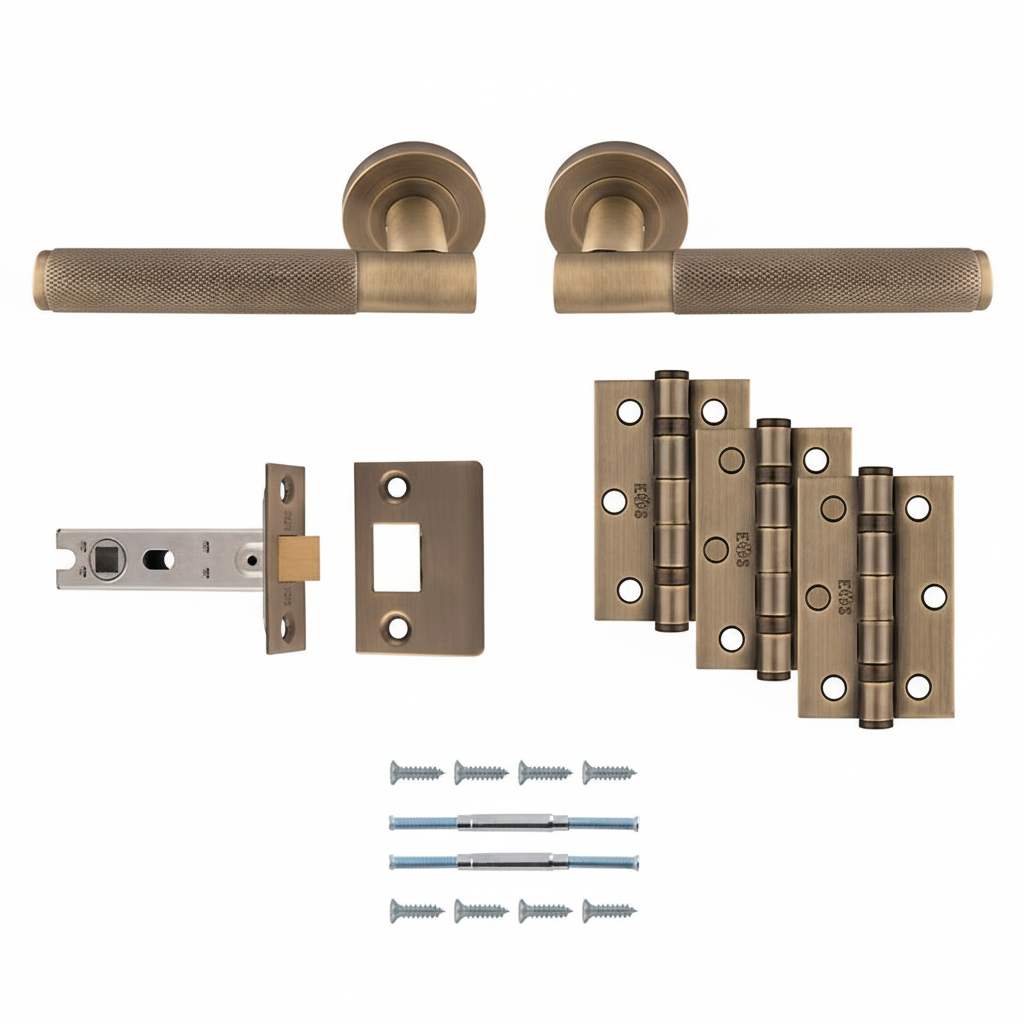
A handle pair does not necessarily include every part needed to make the door work. Depending on the product, the box may contain the handles, spindle and fixing screws, but the tubular latch, sashlock, bathroom lock, keyhole escutcheons or bathroom turn-and-release may need to be ordered separately.


How many handles do you need?
| Door or application | Usual requirement | What to order |
|---|---|---|
| Standard internal hinged door | One handle on each side | 1 pair, or 2 individually sold handles |
| Five ordinary internal doors | Ten handles in total | 5 pairs, or 10 individually sold handles |
| Bathroom or WC door | Two lever handles plus a locking control | 1 handle pair, with a compatible bathroom lock and turn-and-release unless included |
| Key-locking internal door | Two handles and access for the key | 1 lock-handle pair, or 1 pair on roses plus suitable keyhole escutcheons |
| Pair of French or double doors | Potentially two handles per leaf | Usually 2 pairs if both leaves are to have handles; check the inactive leaf arrangement |
| Single pull handle on one face | One pull handle | 1 individually sold pull handle |
| Pull handles on both faces | Two pulls aligned back to back | 1 back-to-back pair, or 2 single pulls with suitable fixings |
| Dummy or non-turning handle | One handle on each face where required | Check whether dummy handles are supplied singly or as a pair |
| Sliding or pocket door | Flush pulls, edge pulls or specialist furniture | Count the pulls required and check whether the set includes both sides |
| Kitchen cabinet or wardrobe | Usually one knob or pull per opening leaf | Usually ordered individually; these are cabinet handles rather than door handle pairs |
The simplest calculation for standard internal doors is:
Handles sold in pairs
Number of doors × 1 pair
Eight doors require eight pairs.
Handles sold individually
Number of door faces × 1 handle
Eight two-sided doors require sixteen individual handles.
Mixed door types
Count each door separately
Separate passage, locking, bathroom, sliding and double doors before ordering.
Products you should not assume are supplied in pairs
Pull handles
Pull handles are often sold individually because many applications need a handle on only one side. Others are supplied as coordinated back-to-back pairs, with fixings that pass through the door. The Polished Stainless Guardsman Back to Back Pull Handles in Pairs illustrate a product where the paired supply is stated explicitly.
Do not buy two separate pulls for back-to-back installation until you have checked the fixing method. Face-fixed, bolt-through and back-to-back fixings are not interchangeable, and visible bolt heads may be unsuitable for the intended appearance or security level.
External and multipoint door handles
Replacement handles for uPVC, composite and multipoint-locking doors are commonly offered as an internal/external pair, but compatibility is far more important than appearance alone. Check the fixing screw centres, spindle-to-cylinder measurement, backplate dimensions, spindle size and whether the arrangement is lever/lever or lever/pad.
A visually similar handle can have different centres and fail to align with the existing multipoint lock. Before ordering, remove no hardware unless it is safe to do so and take measurements from the centres of the relevant spindle, cylinder and screw holes.
Entrance knobs, centre door knobs and finger plates
A centre door knob is decorative pulling furniture fitted to the outside face of an entrance door; it is not necessarily paired with an identical knob inside. Centre knobs, finger plates, push plates and kick plates are therefore commonly listed as individual items.
Dummy handles
A dummy handle is fixed and does not operate a latch. It might be used on a cupboard, the inactive leaf of a double door or a door controlled by a separate catch. Some ranges offer dummy handles individually, while others require adaptation of a standard pair. Check the fixing arrangement rather than assuming a normal sprung lever can simply be screwed to the door without a latch.
Count complete door sets, not just handles
Once you know the number of handle pairs, identify what each door has to do. A house rarely needs the same mechanism on every door.
| Door function | Typical handle format | Usually required behind or alongside it |
|---|---|---|
| Passage door | Lever latch backplate or lever on rose | Tubular latch |
| Key-locking door | Lever lock backplate, or lever on rose with separate escutcheons | Sashlock and, where needed, escutcheons |
| Bathroom or WC | Bathroom backplate, or lever on rose with separate turn-and-release | Bathroom lock and emergency-release furniture |
| Door held shut without a lever | Pull handle or knob | Roller catch, magnetic catch or other suitable closing device |
Our guide to latch, lock and bathroom door handles explains these configurations in more detail.
Important: “Bathroom handles” can mean handles on a bathroom-profile backplate, but that does not guarantee that the locking mechanism is included. Look for a bathroom lock or privacy latch in the contents. A turn-and-release should allow emergency operation from outside.
Read the product listing in this order
- Unit of sale: look for “pair”, “set”, “each”, “single” or a pack quantity.
- Box contents: confirm whether the spindle, screws and bolt-through fixings are included.
- Handle function: establish whether it is a latch, lock, bathroom, dummy, pull or multipoint handle.
- Required mechanism: check whether the latch or lock must be purchased separately.
- Door suitability: confirm door thickness, fixing centres and other listed dimensions.
- Handing: check whether the design is reversible or supplied in left- and right-handed versions.
Product photography is intended to show the design and finish. It may show one handle, a pair, several angles, or components arranged for illustration. It is not a reliable statement of quantity unless the written description says so.
Will a pair of handles fit your door?
Buying the right number does not guarantee a suitable fit. Door handles do not all fit all doors, particularly when replacing existing furniture and hoping to reuse the current latch, lock or drilled holes.
Door thickness and spindle length
The spindle must pass through the latch or lock and engage securely with both handles. If it is too short, one or both handles may not grip it properly. If it is too long, it normally needs to be cut accurately where the product permits. Confirm the stated door-thickness range, especially on unusually thin, thick or rebated doors.
Backset and handle clearance
The backset is the distance from the door edge to the centre of the spindle. A short backset places the lever closer to the frame, which can leave insufficient knuckle clearance behind a long or substantial handle. Check the latch dimensions before drilling a new door.
Backplate holes and rose coverage
Replacement backplates may not share the existing screw centres. A shorter or narrower plate may expose old holes, paint lines or an unfinished area. Lever roses also need enough sound timber for their fixings; they should not rely solely on the thin face material of a hollow door.
Lock and backplate centres
For a keyhole or bathroom backplate, measure from the centre of the square spindle to the centre of the keyhole, cylinder or bathroom follower as appropriate. A mismatch means the plate openings will not align with the lock.
Sprung and unsprung handles
Many lever handles contain spring assistance, but some depend more heavily on the spring in the latch or lock. An unsprung or particularly heavy lever needs a mechanism designed to return it reliably. Otherwise, the handle may droop even when it has been fitted correctly.
Handed designs
Most simple lever pairs can be reversed, but cranked, offset or strongly shaped handles may be handed. Confirm the viewing convention used by the product before choosing left or right; handing descriptions can refer to the opening face, closing face or hinge position.
Worked examples for a home
Suppose a property has six bedroom and living-room doors, one bathroom door, one key-locking study door and a pair of double doors:
- Six passage doors: six pairs of latch handles and six suitable latches.
- One bathroom door: one pair of bathroom-compatible handles, one bathroom lock and a turn-and-release if it is not integrated into the handle set.
- One study door: one pair of lock handles or levers on roses, plus a sashlock and any separate escutcheons required.
- Double doors: usually two pairs if matching handles are wanted on both faces of both leaves, although the inactive leaf may require dummy furniture or different locking hardware.
That project may require ten handle pairs, but it does not require ten identical complete door sets. The function of each door determines the latch, lock and accessory combination.
Checks to make before placing the order
- Count doors, then count the faces that genuinely require a handle.
- Separate ordinary latch doors, locking doors, bathrooms, double doors and sliding doors.
- Confirm whether the listed price is for a pair, an individual handle or a multipack.
- Check whether the spindle and fixings are included.
- Check whether the latch, lock, cylinder, escutcheons or bathroom turn are separate.
- Measure door thickness, existing backplate size, screw centres, backset and lock centres where relevant.
- Confirm handing on non-symmetrical handles.
- For external, communal, security or fire-resisting doors, retain the required door performance and use compatible, correctly specified hardware.
- Order matching items together where possible, particularly where finish consistency across several doors matters.
Do you need a spare pair? It can be sensible on a large matching installation, especially if the design or finish may change in future. Store unused furniture in its original packaging in a dry place. However, do not substitute a spare handle for proper maintenance: loose fixings, a binding latch or a worn lock should be corrected before they overload the lever mechanism.
If the box appears to contain only one handle
Before assuming an item is missing, inspect the packaging carefully. A second lever may be nested beneath a cardboard tray, wrapped back-to-back with the first, or packed in a separate compartment with the spindle and fixings.
Then compare the contents with the product description and packing information. Keep all packaging and avoid fitting the product until the quantity has been confirmed. Fitting can mark screw holes, grub-screw points and decorative surfaces, making it harder to establish how the item arrived.
The dependable buying rule
For a standard two-sided hinged door, allow two handles in total. If the chosen product is sold as a pair, order one pair per door. If it is sold individually, order two handles per door.
Then check what else the door needs: the correct latch or lock, a suitable spindle, compatible fixings and any keyhole or bathroom furniture. Browse our main range of door handles, where the product details should be used to confirm the unit of sale and specification before ordering.
