
Door Knobs vs Lever Handles: Pros, Cons and When to Use Each
For most UK internal doors that are opened throughout the day, a lever handle is usually the more practical choice. It takes less hand strength, can be operated without gripping and suits the way most modern latches and locks are specified. Door knobs still have a strong case, though: they are compact, less prone to catching on passing clothing and can look far more appropriate on period doors or in rooms where a traditional detail matters.
So the useful way to compare door knobs vs lever handles: pros, cons and when to use each is not to ask which is universally better. It is to look at how often the door is used, who needs to operate it, what latch or lock is already fitted and what you want the door furniture to look like.
Lever handles: the practical everyday option
Lever door handles work by pressing the lever down, rotating a square spindle and retracting the latch or lock. That simple action is one reason they are so widely used on bedrooms, living rooms, kitchens, offices and other doors that are opened repeatedly.
Pros of lever handles
- They are easy to operate. A lever does not need to be tightly gripped and twisted. It can often be pressed with a hand, closed fist, forearm or elbow.
- They are useful when your hands are full. Carrying washing, shopping or a box through a door is considerably easier when the handle can be pushed down without wrapping your fingers around it.
- They generally suit accessibility requirements better. The push-down action demands less dexterity than the grip-and-turn movement of a conventional round knob.
- There is a very wide choice of functions. Lever furniture is readily available for latch-only doors, key-operated mortice locks, bathrooms and other applications.
- There are modern and traditional designs. Although levers are commonly associated with contemporary interiors, scroll handles, antique finishes and traditional backplates make them equally usable in older properties.
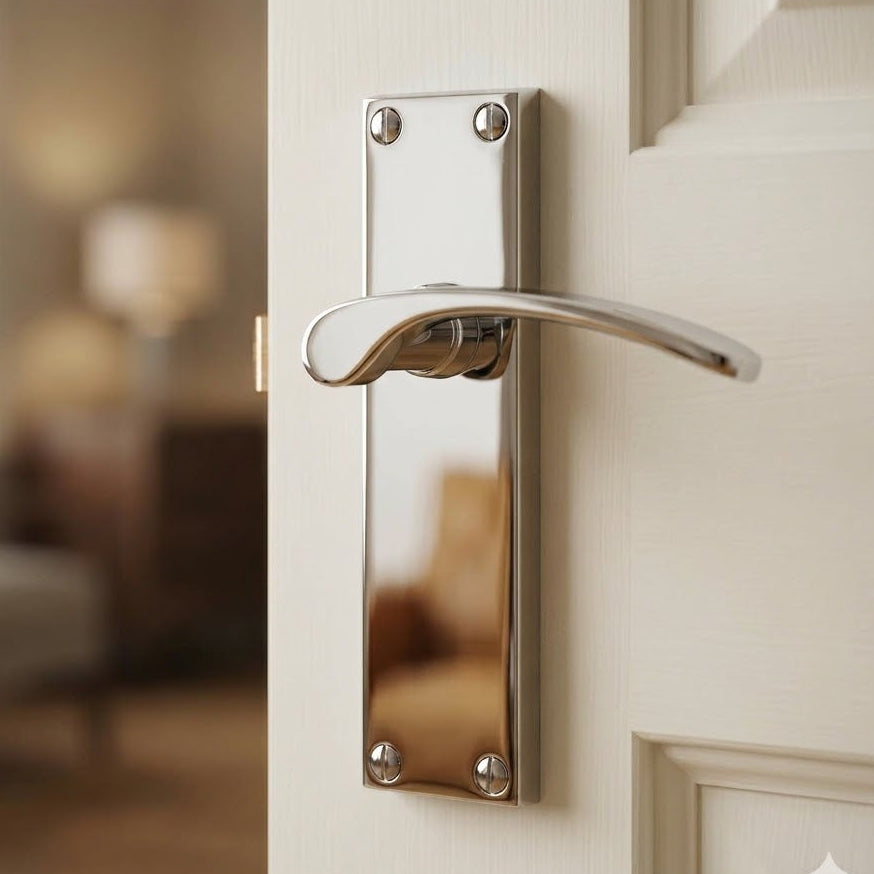
The Sophia polished chrome lever latch handles show the familiar arrangement: pressing the lever rotates the spindle and operates a tubular or mortice latch. Handles of this type are particularly straightforward for frequently used internal doors.
Cons of lever handles
- The projecting lever can catch. Bags, dressing gowns, sleeves and loose clothing can snag on some lever shapes, especially designs with a fairly open end.
- They occupy more horizontal space. A lever extends sideways across the door whereas a compact knob keeps most of its bulk close to the spindle position.
- Some highly decorative designs are vulnerable to knocks. A long or delicate lever may be less suitable in a tight circulation area than a simple compact design.
- They may look wrong on some period doors. A sharply contemporary lever can feel visually out of place on a heavily panelled Victorian or Georgian-style door, although traditional lever designs are available.
If snagging is the main concern but you still want the ease of a lever, look at handles where the end curves back towards the door rather than projecting outwards.
Door knobs: compact, traditional and still genuinely useful
A functioning mortice door knob turns rather than pushes down. Like a lever, it normally rotates a square spindle through the latch or lock, but the user's hand supplies that rotation by gripping the knob itself.
Pros of door knobs
- They project less sideways. There is no lever extending across the door, so a knob is less likely to catch the edge of clothing or a passing bag.
- They suit period interiors naturally. Brass, porcelain, wood and glass knobs work particularly well with panelled doors and traditional architectural details.
- They can make the door look visually quieter. A knob on a small rose occupies less horizontal space than a lever and can let the door itself remain the dominant feature.
- There is considerable design choice. Mortice knobs range from plain ball and mushroom designs to reeded, faceted, porcelain and glass styles.
- They can be useful on occasionally operated doors. Where accessibility and rapid everyday operation are less important, their compactness may be a bigger advantage.
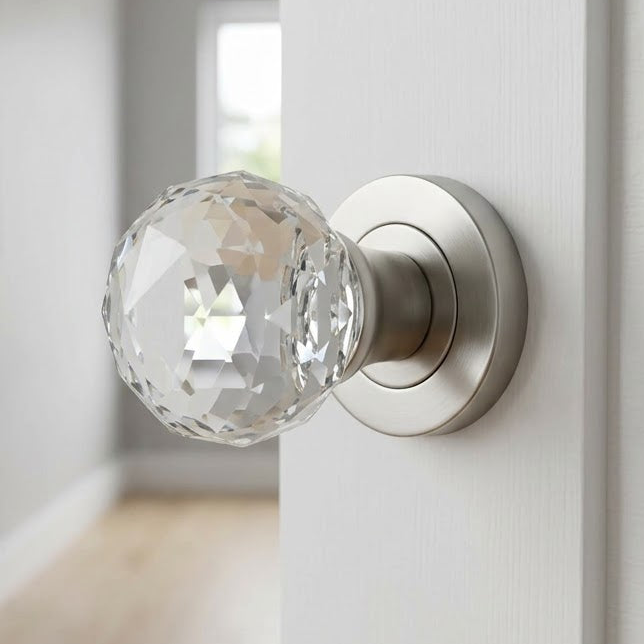
The glass pumpkin mortice door knobs demonstrate why knobs are not limited to plain Victorian-style brass hardware. The compact round rose keeps the fixing visually small while the glass knob becomes the decorative feature.
You can compare more traditional and contemporary options in the mortice door knobs collection.
Cons of door knobs
- They require a grip-and-twist action. That can be awkward for somebody with reduced hand strength, limited dexterity or restricted wrist movement.
- You cannot operate them as easily with an elbow or forearm. That becomes noticeable on frequently used doors or whenever you are carrying something.
- Smooth knobs can be harder to grip. Highly polished spherical designs in particular depend on the user being able to get a secure purchase on the surface.
- Positioning close to the frame can be uncomfortable. If the latch backset is too shallow, your knuckles may come too close to the door frame when turning the knob.
- Changing from a lever is not always a straight swap. The existing latch position, springing, backset and old fixing marks all need checking.
A knob often needs the handle position farther from the door edge
This is one of the most useful practical differences to know before changing from lever handles to knobs.
A lever can usually be operated comfortably when the spindle is relatively close to the door edge because your hand grips the lever away from its pivot. With a knob, your hand surrounds the fitting itself. If the spindle sits too close to the edge, your fingers or knuckles can meet the frame as you turn it.
For that reason, a deeper latch backset is commonly preferred for mortice knobs. Door Furniture Direct's guide to choosing a door knob recommends considering this positioning carefully and notes that a 3in tubular latch is usually used with mortice door knobs.
By comparison, a 2.5in or 64mm latch is commonly used with lever handles. These dimensions are not rules for every product, but they explain why changing the visible furniture without checking the latch first can leave a new knob uncomfortably close to the door edge.
Do not assume a lever and knob can use exactly the same latch
Both types frequently operate a square spindle, so it can appear that replacing one with the other should be a direct swap. Sometimes it is. Sometimes the existing latch or lock is the part that makes the change impractical.
Check the manufacturer's requirements for the new furniture, including:
- spindle size;
- latch or lock backset;
- spring strength;
- whether the knob or lever is itself sprung;
- fixing positions;
- door thickness;
- the space needed between the handle and frame.
Some mortice knobs are sprung, while others rely more heavily on the latch or lock mechanism to return them. The same issue exists with certain lever handles. A latch that worked satisfactorily with one set of furniture may therefore feel weak or fail to return another set correctly.
If you are renovating rather than fitting new doors, decide on the knob or lever before automatically reusing every existing latch.
Locked doors give you another choice: rose or backplate
Neither knobs nor levers are restricted to latch-only doors. Both can be used with appropriate locking hardware, but the way the keyhole or privacy function is presented varies.
A knob or lever on a rose can sit above a separate escutcheon or bathroom turn. Alternatively, a longer backplate can combine the handle position and keyhole in one fitting.
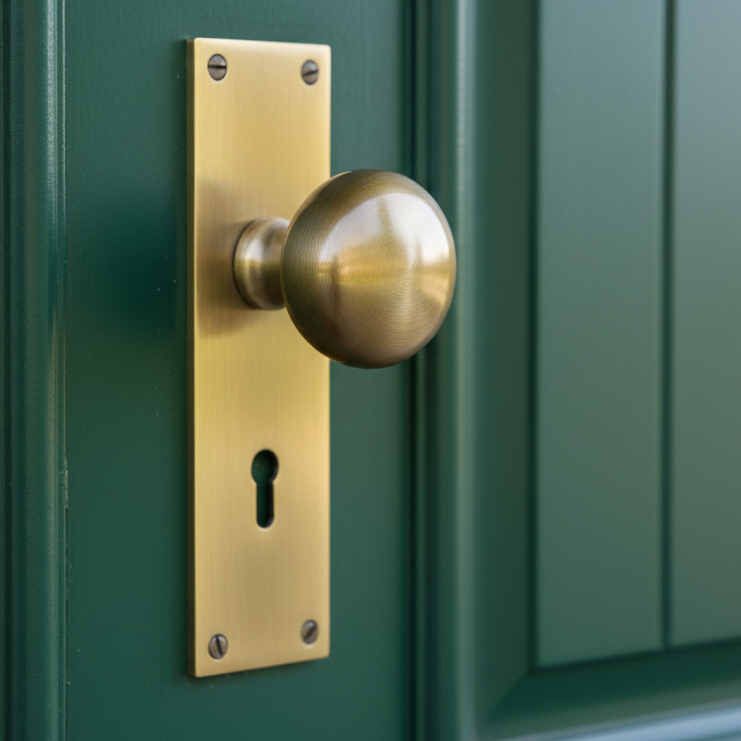
The Balmoral antique brass knob on lock plate, for example, is designed for use with a key-operated mortice sashlock. Its long backplate incorporates the keyhole and gives the complete fitting a deliberately traditional appearance.
Lever furniture offers the same broad choice. The door handles on backplate range includes latch, lock and bathroom configurations, while lever on rose handles can be combined with separate locking or privacy furniture.
Choose lever handles if...
- The door is used repeatedly throughout the day. Bedrooms, kitchens, living rooms and busy circulation doors generally benefit from the quick push-down action.
- Ease of use is a priority. A lever is the stronger choice where children, older occupants or people with limited hand movement need to operate the door comfortably.
- You often carry things between rooms. Being able to depress the lever without gripping it is a small advantage that becomes very noticeable in everyday use.
- You are fitting a typical contemporary internal door. Lever furniture works naturally with the common latch, lock and bathroom arrangements used in modern homes.
- You want one handle family throughout the house. Lever ranges frequently offer latch, lock, bathroom and rose-mounted versions that make it straightforward to coordinate different rooms.
If practicality is driving the decision, start with lever on rose door handles for a compact appearance or backplate handles if you prefer the lock or privacy function integrated into the plate.
Choose door knobs if...
- You are restoring a period property. A well-chosen mortice or rim knob can look much more convincing on an original panelled door than an obviously contemporary lever.
- You specifically want compact door furniture. The lack of a projecting lever can be useful in narrow spaces and places where snagging is irritating.
- The door is operated relatively infrequently. On a study, guest room or other occasional-use space, the extra convenience of a lever may matter less than appearance.
- You want glass, porcelain or traditional brass hardware as a design feature. Those materials and shapes are particularly strongly represented in knob designs.
- You are matching existing period ironmongery. Retaining the same knob style can preserve consistency across a hallway or older property.
Knobs are also common on wardrobes and similar furniture because a compact projection reduces snagging, although furniture knobs and mortice door knobs are different products and should not be treated as interchangeable.
You do not have to use the same type on every door
A house can use lever handles on its busiest doors and knobs in rooms where character or compactness matters more. There is no technical requirement for every internal door to use the same operating shape.
What usually makes a mixed scheme look deliberate is keeping another element consistent: the same finish, similar period detailing or related roses and backplates. Antique brass knobs on original bedrooms can sit comfortably alongside antique brass lever handles on frequently used doors, for example.
Before mixing types, consider who uses each door rather than choosing purely room by room. A beautiful knob on a door that somebody finds difficult to operate will quickly become a poor choice, however well it matches the décor.
For most everyday internal doors, levers have the practical edge
There is a reason lever handles have become the default on so many UK internal doors. They are quick to use, demand less grip and wrist movement and remain convenient when your hands are occupied. For busy doors, those advantages are more important than they initially sound.
Door knobs are not an obsolete alternative. They project less sideways, can reduce snagging and often look far better in a period or traditional setting. With the right latch position and a comfortable knob shape, they can still make excellent functional door furniture.
If you are starting from scratch, choose according to the people using the door and how often it will be opened. If you are replacing existing furniture, add latch compatibility and backset to that decision before ordering. You can then compare both styles across all door handles and the dedicated door knobs range.
